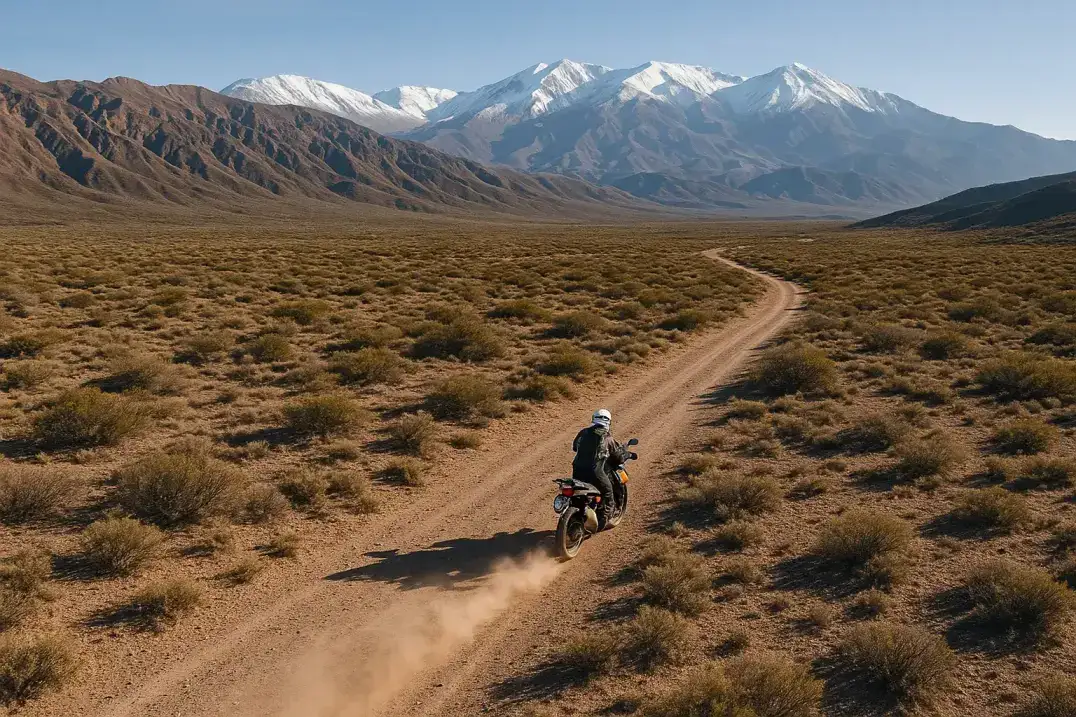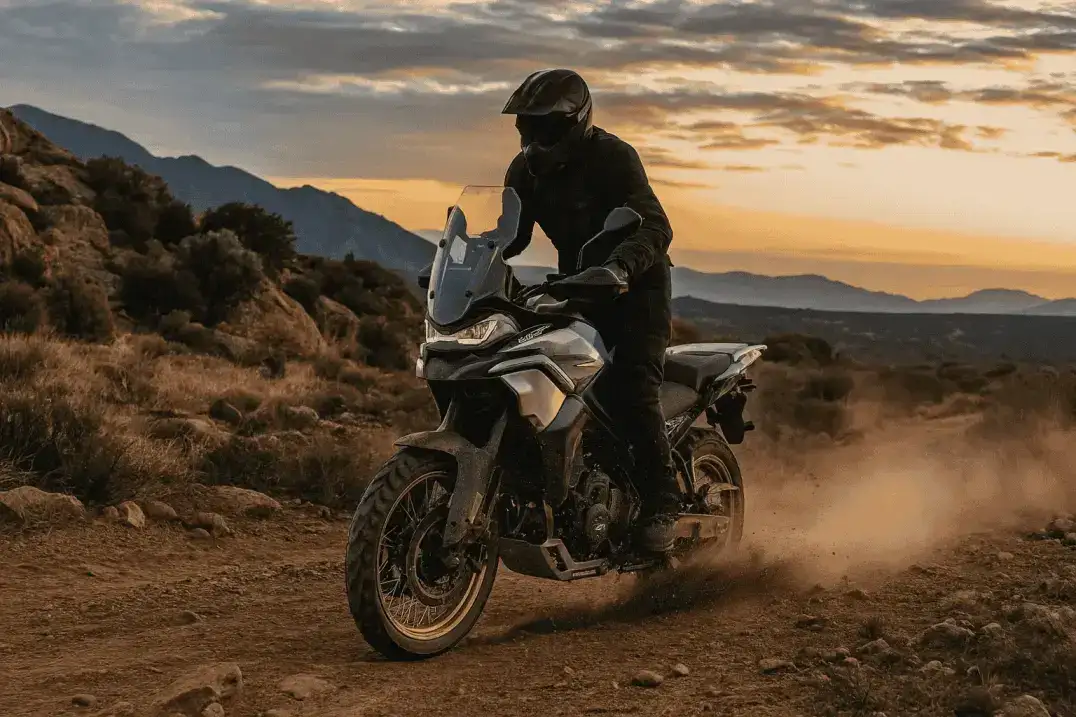
The CFMoto 800MT Explore and the Yamaha Ténéré 700 are USD 700 apart in the US, 23 kg apart on the scale, and built for different roads. The 800MT Explore (sold as the Ibex 800 E in the US) brings 94 hp, a 19-liter tank, cornering ABS, cruise control, heated grips, a center stand and crash bars for USD 10,299. The Ténéré 700 brings 72 hp, 208 kg, 240 mm of ground clearance and a 21-inch front wheel for USD 10,999, and almost nothing else as standard.
Short answer: the Ténéré 700 is the better motorcycle wherever the pavement ends for hours, which is Ruta 40 south of Perito Moreno, the gravel of the Abra del Acay and any day that includes a river crossing. The 800MT Explore is the better motorcycle for long paved days with gravel mixed in, for two riders sharing one bike, and for anyone under about 1.70 m. On our Andes Crossing, where 28 % of the 680 km is gravel and none of it is technical, either works. Above 4,000 m both lose close to 40 % of their power, and the one with more to lose keeps more.
The rest of this comparison is the evidence: the verified 2025/2026 spec sheet, power at altitude segment by segment, range against the real fuel gaps of our route atlas, what it costs to bring a Ténéré up to the Explore’s equipment, running costs over 10,000 km, dealer counts in Argentina and Chile as of October 2026, and a verdict for each kind of trip.
CFMoto 800MT vs Ténéré 700: the spec sheet, verified for 2025 and 2026
Two things to know before the table. First, the names: outside North America CFMoto sells this bike as the 800MT Explore (an “Explore Edition” in some markets); in the US it is the Ibex 800 E, the only 800 trim offered for 2025 and 2026. Same engine, same chassis, same equipment list bar the luggage, which is included in Chile and a USD 1,699 option in the US. Second, the Ténéré 700 was reworked for 2025 (ride-by-wire, two throttle maps, switchable traction control, three ABS modes, a 6.3-inch TFT with navigation and a USB-C port) and the 2026 US model is unchanged at USD 10,999. Figures below are the 2025/2026 model year from the manufacturers’ US and European sheets; the US and European claims differ by a horsepower here and there and we say which we used.
| CFMoto 800MT Explore / Ibex 800 E (2025–2026) | Yamaha Ténéré 700 (2025–2026) | |
|---|---|---|
| Engine | 799 cc DOHC parallel twin, 88 × 65.7 mm, 12.7:1 | 689 cc DOHC parallel twin (CP2), 80 × 68.6 mm, 11.5:1 |
| Claimed power | 94 hp @ 9,000 rpm (US); 70 kW / 95 hp (international brochure) | 54 kW / 72 hp @ 9,000 rpm |
| Claimed torque | 77 Nm @ 6,500 rpm (US sheet; 7,500 rpm in the brochure) | 68 Nm @ 6,500 rpm |
| Measured at the rear wheel | not published by a major test | 61.2 hp @ 9,190 rpm, 42.6 lb-ft (Cycle World dyno, 2025) |
| Wet weight, claimed | 509 lb / 231 kg, full tank, no luggage | 459 lb / 208 kg, full tank |
| Fuel tank | 18.9–19 l | 16 l |
| Claimed consumption | none published in the US | 4.3 l/100 km (WMTC, Yamaha Europe) |
| Seat height | 825 mm | 875 mm (860 mm on the factory Low version) |
| Ground clearance | 190 mm | 240 mm |
| Suspension travel, front / rear | 160 / 150 mm, KYB, adjustable | 210 / 200 mm, KYB, fully adjustable fork |
| Wheels and tires | 19 / 17 in spoked, tubeless, 110/80 R19 + 150/70 R17 | 21 / 18 in spoked, tubes, 90/90-21 + 150/70 R18 |
| Brakes | 2 × 320 mm, J.Juan radial 4-piston; 260 mm rear | 2 × 282 mm, Brembo 2-piston; 245 mm rear |
| IMU and ABS | 6-axis IMU: cornering ABS and TC, wheelie control | no IMU; ABS on / rear off / all off, TC on or off |
| Ride modes | six (Sport, Rain, Off-road, Off-road+, All Terrain, All Terrain+) | two throttle maps (Sport, Explorer) |
| Cruise control | standard | not available, even as an accessory |
| Quickshifter | standard, up and down | USD 199.99 accessory |
| Display | 8-inch TFT touchscreen, CarPlay | 6.3-inch TFT, MyRide turn-by-turn navigation |
| Standard extras | heated grips and seat, center stand, crash bars, skid plate, hand guards, fog lights, TPMS, rear radar (blind spot and rear collision warning), luggage rack | 12 V outlet, USB-C |
| Warranty | 2 years US; 3 years / 36,000 km Argentina | 1 year US; 3 years UK; 3 years / 36,000 km Argentina |
| US MSRP | USD 10,299 | USD 10,999 + 675 destination |
Sources for the CFMoto column: the 2025 Ibex 800 E spec sheet on Motorcycle.com, Rider Magazine’s road test, CFMoto’s international 800MT Explore brochure and CFMoto Chile’s product page. For the Yamaha: Yamaha USA’s 2026 specs, the 2025 European factsheet, ADV Pulse’s 2025 test and MCN’s 2025 review.
Three lines explain most of what follows: 23 kg, 50 mm of travel at each end, and the equipment row. The CFMoto has 22 more claimed horsepower and 9 more Nm; the Yamaha has 50 mm more ground clearance and a front wheel two inches bigger. Everything else is a consequence.
A note on the torque figure, because the internet gets it wrong: several comparison sites list the 800MT at 100 Nm or more. That is the KTM 790 Adventure’s number. CFMoto’s own sheets say 77 Nm for the Explore, and 91 hp / 86 Nm for the 800MT-X, the long-travel sibling.
Engine and power: 22 hp on paper, and what 4,895 m does to both
The 800MT’s 799 cc twin is the engine CFMoto builds under its agreement with KTM, the architecture that powered the 790 Adventure. At sea level the gap is real: 94 hp against 72, 77 Nm against 68, and the CFMoto carries 23 kg more, so it still has about 20 % more power per kilogram with a rider aboard. On the paved climbs out of Salta or up the Cuesta del Obispo, and on the long straights of Ruta 40 with luggage and a headwind, that is the difference between overtaking a truck in fourth and dropping to third.
Cycle World put a 2025 Ténéré on the dyno and measured 61.2 hp at the rear wheel. Nobody has published an equivalent for the 800MT; expect the same 15 % drivetrain loss, so roughly 80 hp at the wheel.
Where this comparison stops being a US-road-test argument is altitude. Neither engine is turbocharged, and a naturally aspirated engine loses about 3 % of its power for every 1,000 ft (305 m) of elevation, the rule of thumb Garrett Motion uses and the one the density of the standard atmosphere roughly confirms (at 4,895 m the air carries 61 % of sea-level oxygen per liter, so the linear rule is slightly pessimistic up high). The Andean Highlands spends two of its ten days largely above 3,000 m, and the Abra del Acay sign says 4,895 m (the SRTM profile in our atlas puts the pass at 4,944 m).
| Elevation | Where on the route | Power left | Ténéré 700 (72 hp) | 800MT Explore (94 hp) |
|---|---|---|---|---|
| 0 m | Osorno, Chile (Andes Crossing start) | 100 % | 72 hp | 94 hp |
| 1,500 m | Just above the Cardenal Samoré pass (1,423 m) and the top of the Siete Lagos (1,168 m) | 85 % | 62 hp | 80 hp |
| 3,000 m | Humahuaca, start of the Hornocal climb | 70 % | 51 hp | 66 hp |
| 4,000 m | Cuesta de Lipán summit (4,192 m); the salt flats beyond sit at about 3,400 m | 61 % | 44 hp | 57 hp |
| 4,895 m | Abra del Acay | 52 % (61 % by air density) | 38 to 44 hp | 49 to 57 hp |
Two conclusions. First, on the Acay the Ténéré has the power of a 400 cc single and the CFMoto the power of a 500 cc twin, and both are carrying 210 to 230 kg plus a rider up a loose gravel grade. The CFMoto’s extra 12 to 13 hp up there matters more than its extra 22 hp at sea level, because it is the difference between second gear and first on the steep hairpins. Second, the segment that sets the pace is not the pass itself: it is the 198 km from Purmamarca to San Antonio de los Cobres (ah4 in our route atlas), of which 185 km are above 3,000 m and 92 km are gravel, ridden at 70 % power or less the whole way. On the next day, San Antonio to Cachi over the Acay (ah5, 144 km, 117 km of gravel, 36 km above 4,000 m), both bikes are at half power and at full weight.
Fuel injection compensates for the thin air, so neither bike needs any adjustment up there; what rises is consumption per kilometer on the climbs, because you ride a gear lower for longer. The penalties in the range table below cover it.
Weight, suspension and wheels: where the Ténéré earns its reputation
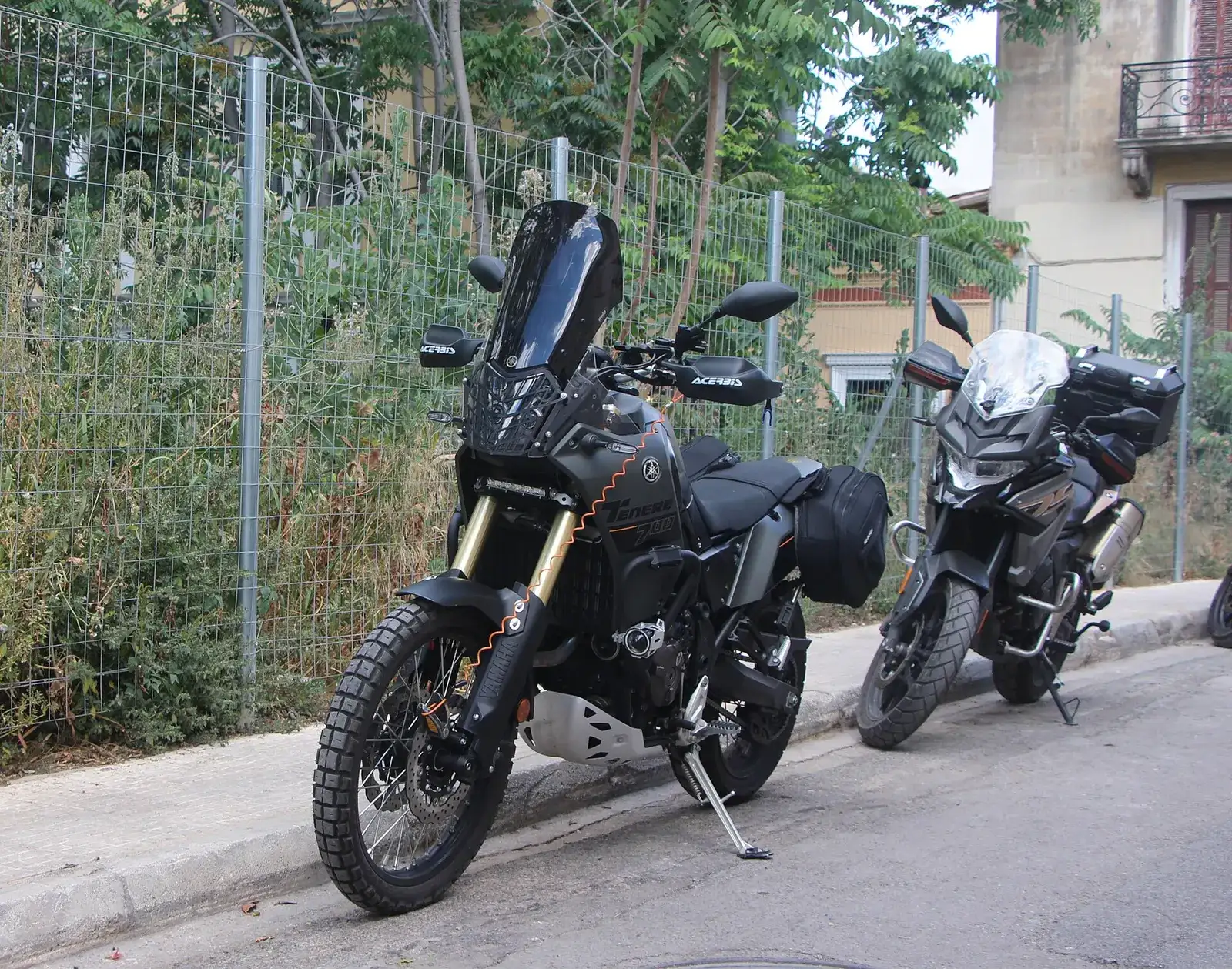
Photo: Wikisympathisant, CC BY-SA 4.0, via Wikimedia Commons.
A 208 kg bike with 210 mm of travel and a 21-inch front behaves like a big dirt bike. A 231 kg bike with 160 mm of travel and a 19-inch front behaves like a road bike that tolerates gravel. Both descriptions are fair, and both bikes do what they were designed to do.
On the washboard of the Hua Hum gravel to San Martín de los Andes (113 km of the segment’s 158 km are gravel), or the track to Pampa Linda under Tronador, the Ténéré floats over the corrugations the CFMoto has to slow down for. Its 240 mm of ground clearance against 190 mm means the skid plate rarely touches anything on the Acay’s rock steps. The 2025 fork is now fully adjustable and MCN found the new shock and linkage more supportive; its remaining criticism of the Ténéré off-road is that it reaches its limits only at a fast pace over big rocks, which is what the Rally version is for.
Picking it up matters more than the brochures admit, because on gravel everybody drops a bike eventually. 208 kg is a one-person lift with the right technique; 231 kg, with the Explore’s weight carried fairly high with a full tank (Rider Magazine’s observation), usually takes two, or one rider with a calm heartbeat. On our tours there is always a second rider or the guide; on your own trip there may not be.
On pavement the picture flips. The CFMoto’s shorter, stiffer suspension and 19-inch front give it more precise steering through the switchbacks of Los Caracoles and less of the tall, vague feeling the Yamaha has at highway speed with a headwind. And the wheels decide how a puncture ends your day: the Explore’s spoked rims are tubeless, so a nail on Ruta 40 is a 15-minute plug by the roadside; the Ténéré runs tubes, so the same nail is a wheel out, tire off, tube out, in the wind, 100 km from the nearest town. Yamaha offers no tubeless rim for it; aftermarket conversions exist for exactly this reason.
Range against the real fuel gaps of Ruta 40 and the Andes
This is where spec-sheet comparisons stop being useful, because what matters is not “range” but whether a specific tank crosses a specific gap on a specific day with wind.
Consumption first, from published data rather than from us. For the Ténéré: Yamaha’s own WMTC figure is 4.3 l/100 km, the Fuelly log of 2025 owners averages 50.9 US mpg (4.6 l/100 km) over 14,874 miles. We use 4.5 l/100 km as the touring figure. For the 800MT Explore there is no official number and few long logs; Rider Magazine’s road test returned 43.8 US mpg, which is 5.4 l/100 km, and we use that.
The penalties are the ones our fuel range calculator applies: +15 % for mixed roads, +30 % for gravel with wind, and 10 % of the tank kept in reserve. The gaps are the longest stretch without a station on each segment of the route atlas, measured from every station within 1.5 km of the road in OpenStreetMap (ODbL); each links to its segment page.
| Gap without fuel (route atlas) | km | Ténéré 700, 16 l, touring (4.5) | Ténéré, +30 % wind/gravel | 800MT Explore, 19 l, touring (5.4) | 800MT, +30 % |
|---|---|---|---|---|---|
| Usable range after 10 % reserve | 320 km | 246 km | 317 km | 244 km | |
Esquel → Perito Moreno, Gobernador Costa to Río Mayo (p2) |
232 | ok | 14 km spare | ok | 12 km spare |
Perito Moreno → Gob. Gregores, Bajo Caracoles to Gregores (p3) |
225 | ok | 21 km spare | ok | 19 km spare |
El Chaltén → El Calafate (p5) |
208 | ok | ok | ok | ok |
Purmamarca → San Antonio de los Cobres (ah4), all above 3,000 m |
198 | ok | ok | ok | ok |
Gob. Gregores → El Chaltén (p4) |
175 | ok | ok | ok | ok |
San Antonio de los Cobres → Cachi over the Acay (ah5) |
143 | ok | ok | ok | ok |
Neltume → San Martín de los Andes via Hua Hum (ac3), the Andes Crossing’s longest |
135 | ok | ok | ok | ok |
Siete Lagos (ac4) |
107 | ok | ok | ok | ok |
Read the table like this. On the Andes Crossing and the Andean Highlands, neither bike needs an auxiliary tank: the longest gaps, 135 km and 198 km, fit inside the worst-case range of both with 50 to 100 km to spare, and the Explore’s bigger tank buys back exactly what its bigger engine spends. The two bikes are, for practical purposes, the same range: about 320 km on a good day and about 245 km on a bad one.
On Ruta 40 south, the two gaps that matter, 232 km and 225 km, are a coin toss on a bad day for both. A bad day on p3 is not rare: the ERA5 record at the segment’s midpoint shows a mean daily maximum wind of 37 km/h in January and 16 days a month with gusts over 60 km/h, 17 in December. The Bandera Blanca pump at Bajo Caracoles (km 130 of p3) is the one that decides whether you make Gobernador Gregores, and a small-town pump in Patagonia can run dry in January and keep short hours in winter. The rules we give riders: fill at every pump on p2 to p5 whatever the gauge says, and never leave Perito Moreno, Bajo Caracoles or Gobernador Gregores on less than a full tank. Our Ruta 40 fuel station guide lists every station and its hours.
If range is the thing you lose sleep over, Yamaha’s answer is not the standard Ténéré but the 2026 World Raid: 23 l in twin tanks, a six-axis IMU with cornering ABS and cruise control, 220 kg claimed, USD 12,999. It closes every gap in the Explore’s equipment list except the heated grips and the center stand, and gives the Ténéré 480 km of touring range. CFMoto’s answer to the off-road argument is the 800MT-X: 230 / 230 mm of travel, 22.5 l, 220 kg, 21-inch front.
Equipment: what the Explore includes, and what it costs to add to a Ténéré
The Explore ships with the list in the spec table. The Ténéré ships with hand guards, a 12 V socket and a USB-C port, and Yamaha sells the rest. These are Yamaha USA’s own accessory prices in October 2026, for the parts that replicate what the Explore has as standard:
| To match the Explore | Yamaha genuine accessory | USD |
|---|---|---|
| Heated grips | Ténéré 700 Heated Grip, BRL-H29A0-V0-00 | 234.99 |
| Center stand | Ténéré 700 Main Stand | 379.99 |
| Crash bars | Ténéré 700 Engine Guard | 339.99 |
| Skid plate | Ténéré 700 Skid Plate (HD aluminum: 419.99) | 384.99 |
| Luggage rack | Ténéré 700 Rear Rack | 399.99 |
| Pannier mounts | Ténéré 700 Side Case Mounts | 469.99 |
| Quickshifter | Ténéré 700 Quick Shifter | 199.99 |
| Total | 2,409.93 | |
| Not available at any price | cruise control, heated seat, TPMS, cornering ABS, radar |
So a Ténéré equipped like an Explore is USD 10,999 + 2,410 = USD 13,409 before tax and labor, against USD 10,299 for the Ibex 800 E: a gap of USD 3,110, not 700. Add luggage and the gap stays: two Yamaha side cases at 449.99 each take the Ténéré to USD 14,309; CFMoto’s three-piece aluminum set at USD 1,699 takes the Ibex to USD 11,998. In Chile the Explore’s two side cases and top box are included in the price, and the gap is wider still.
Whether the equipment is worth USD 3,000 depends on where you ride. Heated grips are not a luxury on the Lipán in October, where the ERA5 record for ah4 gives a mean daily minimum of 1.8 °C and 18 days a month with gusts over 60 km/h, nor on the Acay, where ah5 logs 22 such days. Cruise control matters on the 538 km of p2. The center stand matters every time you lube a chain in a hostel car park. The radar and the heated seat are the two items Rider Magazine’s tester would have switched off: the radar alerts became a nuisance in traffic, and the seat above its medium setting was too hot to sit on.
What the Ténéré’s price buys that you cannot add to the CFMoto is the absence of things: no IMU to fail, no touchscreen, no radar module, switchgear that a Yamaha dealer in Río Gallegos has seen before. MCN scored the 2025 Ténéré 5 out of 5 for reliability and build quality and wrote that the lack of lean-sensitive electronics “is done purposefully by Yamaha, in order to keep things as simple as possible”. Rider’s criticisms of the Ibex are all electronics and interface: a menu system with functions buried too deep, a pulsing display ring that cannot be switched off, radar alerts, a narrow clutch friction zone. None is trip-ending. All are things you will live with for ten days.
Running costs over 10,000 km
A trip across Patagonia and back, or two Andean tours, is roughly 10,000 km. Here is what each bike asks for in that distance, from the service schedules as reproduced from the owner’s manuals by maintenanceschedule.com for the Ténéré 700 (Yamaha manual BHL-28199-E0-S0) and for the 800MT / Ibex 800.
| Over 10,000 km | Ténéré 700 | 800MT Explore |
|---|---|---|
| Oil and filter | every 10,000 km / 1 year (Europe); every 6,000 km / 6 months (US manual): 1 to 2 changes | every 5,000 km / 12 months (US manual); every 15,000 km (rest of world): 1 to 2 changes |
| Valve clearance check | every 40,000 km: none due | every 30,000 km: none due |
| Fuel at the touring figures above | 450 l | 540 l |
| Fuel cost difference at Argentine pump prices | 90 l × ARS 2,090 (YPF súper, Buenos Aires, 2026) = about ARS 188,000, about USD 125 | |
| Tires | 90/90-21 front, 150/70-18 rear, tubes | 110/80 R19 front, 150/70 R17 rear, tubeless |
| Rider-fixable roadside puncture | no (tube change) | yes (plug) |
The consumption gap is small money: USD 125 over 10,000 km, or less than a night in a Bariloche hotel. The real running-cost differences are the valve interval (the Ténéré’s 40,000 km is the longest in the class and means a two-year owner may never pay for a valve check) and the tires.
On tires, the sizes decide what you will find in a shop 1,500 km from Buenos Aires. The Ténéré’s 21/18 combination is the one shared by the KTM 890 Adventure, the Africa Twin, the Transalp and the Tuareg 660, the bikes that go on the big adventure tours; the Explore’s 19/17 is the road-biased adventure size it shares with the Multistrada V2. Both are catalog sizes for Metzeler, Michelin and Pirelli; which one a given shop in Esquel or Cafayate has on the shelf on a Tuesday is a different question, and the honest answer for either bike is to leave with the tires you need for the whole trip.
Dealers and support in Argentina and Chile
Counted on the brands’ own locators on October 30, 2026. “Dealer” means a point that sells motorcycles; Yamaha Argentina’s locator also lists parts-only points, which we excluded.
| Network (October 2026) | Total | In Patagonia (Neuquén, Río Negro, Chubut, Santa Cruz, Tierra del Fuego) | In Salta and Jujuy |
|---|---|---|---|
| Yamaha Motor Argentina | 187 selling motorcycles, 175 with a workshop | 6: Neuquén, Bariloche, Trelew, Comodoro Rivadavia, Río Gallegos, Río Grande | 12: six in Salta province (four in Salta city, two in Tartagal), six in Jujuy |
| CFMoto Argentina | 36 (the brand says “casi 40”) | 2: Neuquén, Puerto Madryn | 1: Salta city; none in Jujuy |
| Yamaha Chile | 33 | 4 south of the Biobío: Temuco, Osorno, Puerto Montt, Punta Arenas | n/a |
| CFMoto Chile | 15 dealers, 19 authorized workshops | 5 workshops south of the Biobío: two in Temuco, Osorno, Dalcahue (Chiloé), Punta Arenas | n/a |
What this means on the ground. Yamaha has a dealer with a workshop in Bariloche, where our tours are based, and in Neuquén, Trelew, Comodoro Rivadavia, Río Gallegos and Río Grande; CFMoto’s nearest point to Bariloche is Neuquén, about 430 km away, and its nearest to the Ruta 40 south of Esquel is Puerto Madryn on the Atlantic. In the Northwest, Yamaha has four dealers in Salta city and six in Jujuy province; CFMoto has one in Salta and none in Jujuy. Neither brand has anything in Esquel, San Martín de los Andes, El Calafate, Cachi or Cafayate. On the Chilean side of the Andes Crossing the two networks are almost equal: both have Osorno, where the tour starts, and both have Temuco and Punta Arenas.
The counts are only part of it. Yamaha has built the CP2 engine since the 2014 MT-07, and the current Ténéré 700 reached Argentine dealers in May 2025 with a 3-year / 36,000 km warranty; the parts system has had a decade to stock the engine. CFMoto’s 800MT line arrived in Argentina in 2023, also with 3 years / 36,000 km, and the family is now common in Buenos Aires and Santiago. The risk with the Explore in a small town is not the engine, which is shared with the 800NK and the Ibex and is KTM-derived, but a sensor, a switch cluster or a radar module that nobody within 500 km has in a drawer. We covered CFMoto’s build quality and the KTM relationship in our CFMoto 800MT Explore review, where the brand sits among Chinese manufacturers in our reliability ranking, and the broader question in are Chinese motorcycles good.
What they cost in the US, Argentina and Chile
Argentine and Chilean prices move with the exchange rate and with import taxes, so these are dated and in local currency.
| 800MT Explore / Ibex 800 E | Ténéré 700 | Gap | |
|---|---|---|---|
| United States, MSRP | USD 10,299 | USD 10,999 | +7 % for the Yamaha |
| Argentina | ARS 22,152,990 (October 2025 list), about USD 14,800 at the rate used below | USD 19,950 / ARS 29,250,000 (August 2026) | +32 % |
| Chile, list price | CLP 12,490,000, or 10,300,000 for cash (CFMoto Chile, side cases and top box included) | CLP 14,490,000, or 13,990,000 with Yamaha’s discount (Yamaha Chile) | +16 % list, +36 % cash |
| UK, for reference | £7,999 for the 800MT-X (MCN) | £10,108 (MCN) | +26 % |
The pattern is the same everywhere: the Yamaha costs more and comes with less, and the gap is widest in the two countries you would ride them in. Resale is the one line we cannot put a verified number on: the comparison sites that call the Ténéré the better keeper of value publish no data, and the CFMoto has not been on the Argentine used market long enough to know. Anyone buying a bike to sell after one trip should price that uncertainty against the USD 3,000 of equipment.
Seat height, two-up, and the Shared Ride question
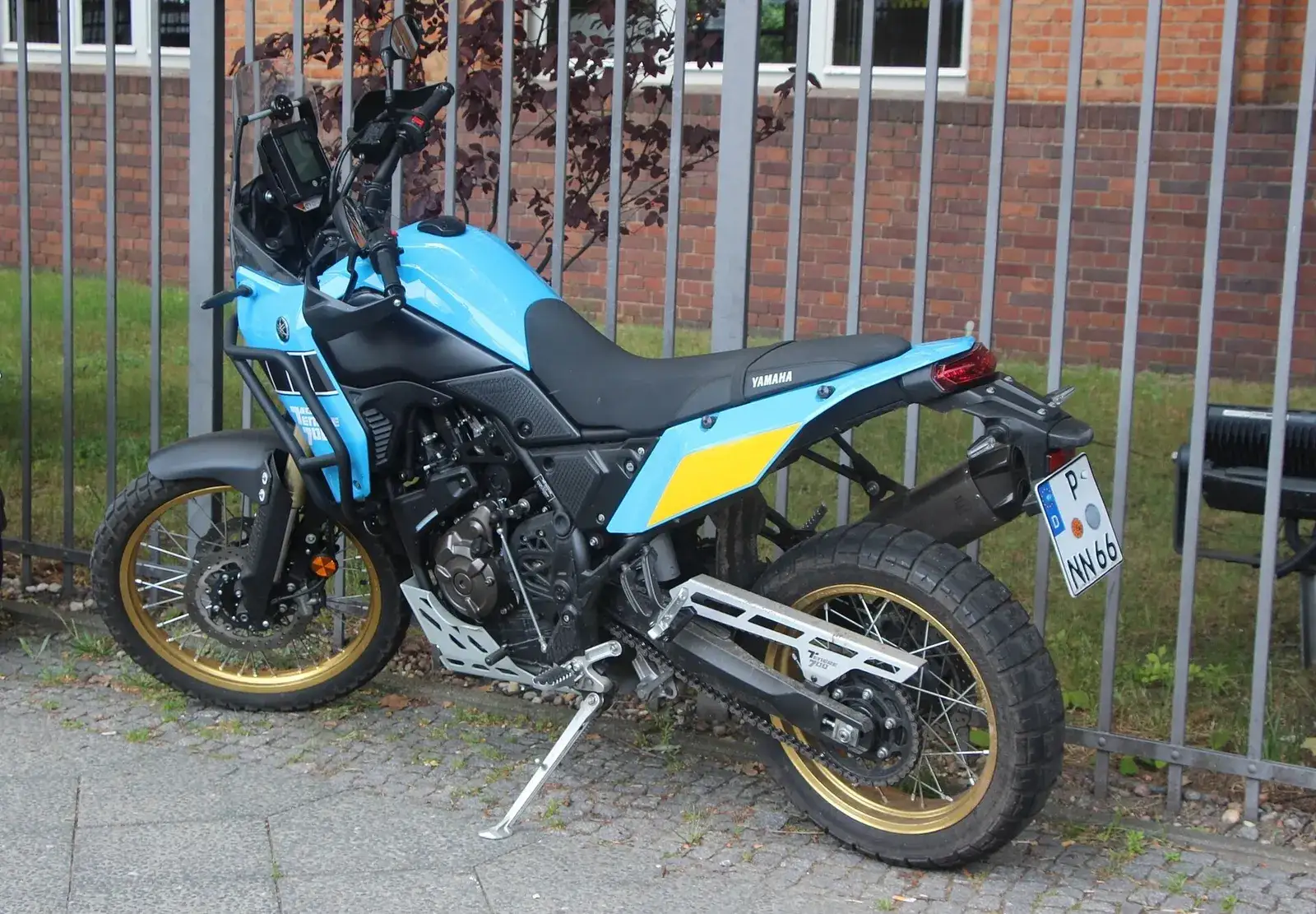
Photo: Wikisympathisant, CC BY-SA 4.0, via Wikimedia Commons.
The CFMoto’s 825 mm seat is one of the lowest in the class; the Ténéré’s 875 mm is one of the tallest, and the seat is narrow, which helps. For a rider of 1.70 m the difference between flat feet at a gravel stop on the Acay and tiptoes on loose stones is the difference between a relaxed day and a tense one. Yamaha’s fixes cost money and clearance: the factory Low version (860 mm) uses shorter suspension with 190 / 180 mm of travel, the Low Seat accessory is USD 219.99 and the Lowering Link Kit USD 149.99, and each takes back part of the 50 mm of ground clearance that is the Ténéré’s main argument.
For two people the CFMoto is the more comfortable bike by a distance: wider seat, lower passenger pegs, a heated pillion seat, a luggage rack and crash bars already fitted, and 94 hp to pull two riders and their kit up the Lipán. On our tours two riders can share one motorcycle in the Shared Ride format (USD 10,350 total for both on the Andes Crossing, against USD 7,850 each solo), taking turns at the controls and switching whenever they both decide; the support van carries the luggage and is backup, not a daily seat. The 800MT Explore is the bike we would point that pair towards. The Ténéré carries two people fine for a day; for ten days, the person on the back will have opinions, and MCN’s note that the engine runs out of top end with luggage or a pillion aboard is the polite version.
Verdict by scenario
| Scenario | Pick | Why, in one line |
|---|---|---|
| Andes Crossing: Osorno to Bariloche, 680 km, 28 % gravel, none technical, max 1,168 m | Either; Explore if sharing | The gravel is Hua Hum and Tronador, not the Acay; the wet Chilean side rewards cornering ABS and heated grips; longest fuel gap 135 km |
| Andean Highlands: 1,110 km, 36 % gravel, two days above 3,000 m, Acay at 4,895 m | Ténéré 700 | 23 kg less to pick up on a loose hairpin at half power; 240 mm of clearance on the Acay’s rock steps; the Explore’s extra 12 hp at altitude is real but does not offset the weight |
| Ruta 40 south, Bariloche to El Calafate, 1,690 km, gaps of 225 to 232 km, 16 to 20 windy days a month | Ténéré 700, narrowly | Same range (245 km usable on a bad day for both); the Yamaha’s tubes are the weak point, the CFMoto’s weight in a crosswind is the other; cruise control and the 19 l tank argue for the Explore if you stay on the paved sections |
| Two-up or Shared Ride, ten days | 800MT Explore | Wider seat, heated pillion seat, rack and bars included, 94 hp for two |
| Rider under 1.70 m | 800MT Explore | 825 mm against 875 mm; the Ténéré’s lowering options cost USD 150 to 220 and clearance |
| First big trip, little mechanical experience | Ténéré 700 | Fewer systems to fail, tubes aside; 187 Yamaha dealers in Argentina against 36; 40,000 km valve interval |
| Mostly pavement, Mendoza to Salta, long days | 800MT Explore | Cruise, quickshifter, 8-inch screen, tubeless, more power per kilogram at every altitude |
| One bike to own for five years in Argentina | Ténéré 700 | Dealer density, parts, resale in dollars; price the USD 3,000 of equipment against that |
Our fleet is mid-range adventure bikes of 500 to 850 cc, exactly this class, and the itinerary decides the bike more than the rider does. For the Andes Crossing, from Osorno through the Chilean lakes, the Hua Hum ferry and the Siete Lagos to Bariloche and Tronador, the Explore is the more comfortable ten days, especially for a Shared Ride pair, and its electronics make the wet Chilean side easier. For the Andean Highlands, the Ténéré’s weight and travel are worth more than the CFMoto’s horsepower on the Acay, Lipán and the gravel Ruta 40 between Cachi and Cafayate. Thin air takes power from both; it takes weight from neither.
If you are choosing a bike for a trip rather than to own, the choice is one of the things a tour removes: our Argentina and Chile motorcycle tours include the motorcycle, the Chilean paperwork for the border and the support van. To compare the whole field, the adventure bike comparator puts nine bikes side by side, and our ranking of the best middleweight adventure bikes places both of these among them. Both also feature in our top 3 for off-road adventure riding and our guide to choosing an adventure bike for the Andes.
FAQ
Is the CFMoto 800MT Explore reliable enough for a two-week trip? Yes. The engine is the KTM-derived 799 cc twin shared across CFMoto’s 800 range and the chassis is solid; in Argentina it carries a 3-year / 36,000 km warranty. The published criticisms are all electronics and interface (menus, radar alerts, a pulsing display), not mechanical. The real risk is the thinner dealer network: 36 points in Argentina against Yamaha’s 187, and none in Patagonia except Neuquén and Puerto Madryn.
Is the Ténéré 700 better than the 800MT off-road? Yes, clearly. 23 kg lighter, 50 mm more travel at each end, 50 mm more ground clearance and a 21-inch front wheel. Its off-road weaknesses are tubes, which make a puncture a wheel-off job, and a seat that is tall for shorter riders. CFMoto’s answer to the off-road argument is the 800MT-X (230 / 230 mm of travel, 21-inch front, 22.5 l), not the Explore.
Which has more range, the Ténéré 700 or the 800MT? In practice, the same. The Ténéré’s 16 l at 4.5 l/100 km and the Explore’s 19 l at 5.4 l/100 km both give about 320 km usable at touring pace and about 245 km with a 30 % wind-and-gravel penalty and 10 % in reserve. That covers every gap on our two tours (longest 198 km) and makes the 225 km and 232 km gaps of Ruta 40 south a coin toss on a windy day for both.
How much power do they lose at altitude? About 3 % per 300 m for any naturally aspirated engine. At the Abra del Acay (4,895 m) the Ténéré has roughly 38 to 44 hp and the Explore 49 to 57 hp, and the day before, from Purmamarca to San Antonio de los Cobres, both run at 70 % or less for 185 km.
Is the Ténéré 700 too tall for shorter riders? At 875 mm it is tall but narrow, so many riders of 1.70 m manage. Below that, the factory Low version (860 mm), the USD 219.99 Low Seat or the USD 149.99 lowering link bring it down at the cost of ground clearance. The Explore’s 825 mm seat is the simpler answer if seat height is the main concern.
Do I need to own either of these to ride with you? No. Our tours include a mid-range adventure bike in exactly this class, Chilean-registered so it can cross the border under the rental regime, with the paperwork prepared in advance. Tell us your height, your gravel experience and whether you are riding solo or in a Shared Ride pair, and we will match the bike; the contact page is the place to start.