Introduction
Somewhere around the third planning session, every rider runs into the same wall: Argentina is 3,700 km (2,300 mi) long from the subtropical north to Tierra del Fuego, the riding seasons in those regions barely overlap, and the paperwork, money, and logistics questions all seem to depend on each other. Most riders solve this by postponing the decisions until the trip is close, which is exactly how people end up paying peak-season prices for the wrong month in the wrong region.
This guide is the master document for how we’d plan a motorcycle trip to Argentina in 2026, organized as a timeline: what to decide 12 months out, what to lock in at six and three months, what to handle in the final weeks, and how to run the plan day by day once you’re riding. It reflects what we do when we build trips for visiting riders, applied to a self-organized ride. Follow the sequence and the decisions stop depending on each other, because each stage closes the questions the next stage needs answered.
Twelve to six months out: shaping your motorcycle trip to Argentina
When to go: matching the season to the region
Argentina punishes riders who pick dates before picking a region. Patagonia rides best from November to March, when the southern summer opens the mountain passes and the famous routes (Ruta 40, the Lakes District, the crossings to Chile) are reliably open. The Northwest (Salta, Jujuy, Cafayate) is the opposite: its dry, ridable window runs roughly April to November, because the southern summer brings storms and washouts to the high desert. Central Argentina (Mendoza, Córdoba) is usable most of the year with shoulder-season caveats.
The practical move is to pick the region first, then the month. If Patagonia is the heart of your trip, plan around December to February for the warmest weather and accept the wind, or November and March for fewer crowds at the cost of colder mornings. If you’re drawn to the Andean Northwest, flip the calendar and aim for May to October. Our best time to ride Patagonia guide breaks the southern window down month by month, including the wind and crowd trade-offs inside the high season.
A year out is also when you should block the time off honestly. Argentina is not a long-weekend destination. The minimum worthwhile trip is about a week in a single region; two weeks lets you ride a real route (Mendoza to Bariloche, or Bariloche to El Calafate) without daily time pressure; three weeks or more opens the end-to-end rides. Riders who compress a two-week route into nine days spend the whole trip looking at the odometer instead of the Andes.
Your bike: rent, ship, or buy
For most international riders the realistic options are renting a motorcycle in Argentina or shipping your own bike, and renting wins for trips under a month. A mid-size adventure bike from a reputable rental operation in 2026 runs roughly $150 to $250 USD per day depending on the model, with mandatory insurance included, and it arrives with the local plates, papers, and roadside process already solved. Shipping your own bike makes sense for multi-month South America trips, but the air or sea freight, customs handling, and crating typically add up to $2,000 to $4,000 USD round trip and two to six weeks of logistics on each end.
If you’re renting a motorcycle in Argentina, reserve the specific model six or more months ahead for a December to February Patagonia trip. Rental fleets in Argentina are small compared to Europe or North America, and the 700 to 900 cc adventure class (the sweet spot for Patagonian distances and gravel) books out first. If you’re unsure what class to ride, our guide to the best mid-range adventure motorcycles for long-distance touring explains why the middleweights fit this country better than the 1,250 cc flagships.
Buying a bike locally to ride and resell is the third path, and we’d skip buying unless you have months and patience. Argentine vehicle bureaucracy is slow, transferring a title as a foreigner requires a local tax ID and address, and reselling at the end collides with the same process in reverse. The riders who make it work are the ones on six-month timelines who treat the paperwork as part of the adventure.
Route shape: how much ground you can actually cover
The single most common Argentina motorcycle trip planning mistake is measuring the route in map distance instead of riding days. On paper, 500 km (310 mi) is an easy day. In Patagonia, with fuel stops every 100 to 200 km, a sustained crosswind, photo stops, and a border crossing or gravel section thrown in, 350 to 400 km (217 to 249 mi) is a full, satisfying day, and 300 km is smarter on gravel-heavy stretches.
Build the route skeleton as riding days plus rest days, not kilometers. A two-week trip realistically holds 10 to 11 riding days once you subtract arrival, departure, and at least two rest days. At 350 km per riding day, that’s roughly 3,500 km (2,175 mi) of total range, which is exactly a Mendoza to El Calafate run or a generous Lakes District and Carretera Austral loop, not both. Choose one ride and do it well; the country will still be here for the second trip.
Six to three months out: paperwork and reservations
Visa, passport, and entry rules
The entry side is the easy part for most readers. Citizens of the US, Canada, the UK, the EU, Australia, and New Zealand enter Argentina visa-free for up to 90 days as tourists, with a passport that should be valid for at least six months beyond your entry date. The stay can be extended once through the immigration office if a longer trip develops. Rules do change, so confirm your nationality’s current status on the Argentine foreign ministry’s visa page when you start booking.
Three months out is the moment to photograph and cloud-store every document: passport photo page, driver’s license (both sides), insurance certificates, rental confirmation, and later the entry stamp and bike paperwork. Argentine police checkpoints are routine and unthreatening, but they ask for documents, and a phone folder with everything in one place turns a 15-minute stop into a two-minute one.
License, IDP, and insurance
Bring your home motorcycle license and add an International Driving Permit (IDP). Argentina broadly honors foreign licenses for tourists, but rental companies commonly require the IDP, and any license not in Spanish or English is effectively unusable at a checkpoint without one. The IDP costs little, takes days to issue in most home countries, and removes an entire category of roadside friction.
Insurance splits into three layers, and the bike’s liability insurance is non-negotiable: third-party coverage (responsabilidad civil) is mandatory in Argentina and is included with any legitimate rental. The second layer is the rental’s damage coverage; read the deductible carefully, because gravel drops are the most common claim on Patagonian rentals. The third layer is your own travel medical insurance with motorcycle riding explicitly covered, which many standard travel policies exclude. Check the exclusion list for “motorcycling above 125 cc” wording before you buy.
If you bring your own bike: the TVIP
Riders shipping their own machine need a Temporary Vehicle Import Permit. The TVIP is issued free at the border or port of entry, and since the 2025 rule changes the permit length is set by your nationality, typically three months, with eight-month permits available in many cases. The bike must leave Argentina before the permit expires; overstaying a TVIP risks fines and, in the worst case, the bike itself.
The working documents are the original title, registration, and your passport, plus the insurance you arranged for the region. Crossing into Chile and back (which most Patagonian routes do anyway) resets the permit, and that loop is the standard way long-haul riders keep a bike legal through a season. Keep the TVIP paper physically with the bike documents; it gets checked at every subsequent border.
Three months to one month out: bookings, budget, and gear
Lodging strategy for high season
If your route touches Patagonia in January or February, book the bottleneck towns three to four months ahead: El Calafate, El Chaltén, Bariloche, and any small town that’s the only overnight within 200 km. Outside those pinch points, and outside peak weeks, Argentina rewards flexible riders, and a mix of two or three anchored bookings plus open nights in between gives you weather flexibility without gambling the whole trip.
For the open nights, hosterías and cabañas are the rider’s default: family-run, $50 to $90 USD in most towns, almost always with somewhere sheltered to park the bike. Mid-range hotels in the hub towns run $80 to $140 USD in 2026. Booking platforms cover the hubs well, but in the smallest towns the real inventory is on WhatsApp, not on the apps, which is another argument for keeping some nights unbooked and asking locally.
What Argentina actually costs in 2026
Argentina’s money situation simplified dramatically after the currency controls were lifted in April 2025. The parallel exchange rates that defined the 2022 and 2023 trip reports have converged with the official rate, foreign cards are charged at the market-linked MEP rate automatically, and the elaborate cash-smuggling rituals in older forum posts are obsolete. Prices in dollar terms have risen as the economy stabilized, so treat pre-2025 budget numbers in blogs as history, not data. Plan a motorcycle trip to Argentina with 2026 numbers or the budget will be fiction.
As a 2026 planning band, a self-organized two-week trip runs roughly $4,500 to $7,000 USD per rider excluding flights: the rental is the biggest line ($2,100 to $3,500), then lodging ($900 to $1,800), fuel (a few hundred dollars for 3,500 km), food, and a buffer for the border fees, park entrances, and the one unplanned night a weather day forces. Couples sharing a bike and a room land meaningfully cheaper per person; solo riders in January land at the top of the band.
Gear: what to bring and what to leave
Pack for four seasons in one trip, whatever the month. A January day in Patagonia can open at 4 °C (39 °F) in El Chaltén and close at 28 °C (82 °F) after the wind dies, and the Northwest’s altitude does the same trick in reverse. The layering answer is the same one that works in the Alps or the Rockies: a waterproof adventure suit, a real mid-layer, summer gloves plus a winter pair, and a buff for the dust.
Resist the urge to bring the garage. Rentals come with panniers, tools, and usually camping-grade extras on request, and Argentine hardware stores and YPF stations solve most consumables. The things worth flying in are the personal ones: your helmet, your earplugs (the wind makes them mandatory equipment, not an accessory), glove liners, any medication, and a 12 V or USB charging solution you’ve already tested on your own bike.
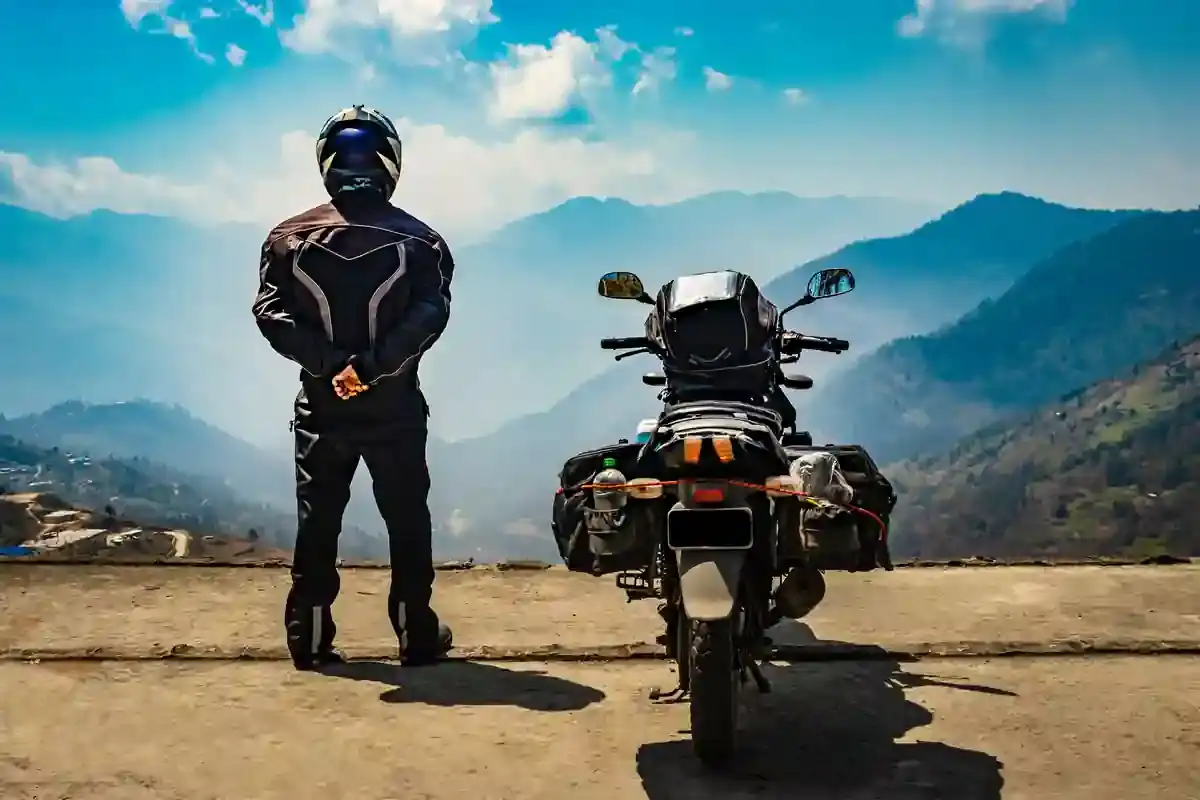 Gear sorted, panniers packed. The preparation phase ends where the riding begins.
The final month: money, maps, and connectivity
Money setup
Set up two cards and some cash. A Visa or Mastercard is now the primary payment tool in Argentina; both apply the market-linked tourist rate to foreign cards, card acceptance in cities and hub towns is near-universal, and the old advantage of cash-only exchange has mostly evaporated. Amex barely works outside Buenos Aires hotels. Carry a second card in a separate bag for the day the first one gets eaten or frozen.
Cash still matters in exactly the places a motorcycle goes. Carry enough pesos for two tanks and one night at all times south of Bariloche, because small-town fuel stations and hosterías remain cash territory, and a 10 to 20 percent cash discount is still common in family restaurants. Bring a few crisp $100 USD bills as the reserve layer; they exchange easily at banks and casas de cambio, and they’re the universal backstop if a card network has a bad day.
Navigation, connectivity, and the documents folder
Phone coverage follows the pavement in Argentina, which means expect dead zones on exactly the best roads. Download offline maps for the whole route (the standard map apps all work; the offline step is the part riders skip), and carry the route as GPX on a second device or the bike’s unit if it has one. An Argentine eSIM bought before the flight is cheap and activates at the airport; data plans from the local carriers are inexpensive by US and European standards.
The final-month admin pass takes one evening: confirm the rental, re-check the bottleneck bookings, and print nothing. Everything lives in the phone folder you built three months ago, now updated with booking confirmations and the rental contract. Add the emergency numbers (911 works nationally, the rental’s roadside line, your insurer’s assistance line) as actual contacts, because typing them off a PDF on a windy roadside is nobody’s best moment.
The final week and arrival day
Final checks at home
The last week is for the boring checks that save trips. Call your card issuers and flag the travel dates, confirm your medical policy’s motorcycle clause in writing, weigh the luggage against the airline’s allowance with the helmet in hand, and ride your local roads once in the full kit you’re flying with, because the final week is when the zipper that’s been thinking about failing makes its move.
Build slack into the front of the trip. Land at least one full day before the rental pickup, two if you’re connecting through Buenos Aires to a domestic flight. Argentine domestic connections involve an airport change in Buenos Aires more often than visitors expect (Ezeiza international to Aeroparque domestic is a 45-minute taxi on a good day), and a lost-bag day at the start is recoverable only if you gave it room to exist.
Landing in Argentina
Arrival day has one job: convert jet lag into setup, not riding. Pick up the eSIM data plan, get the first pesos, do the rental walkthrough in daylight with photos of every existing scratch, and ride 20 unhurried kilometers to feel the bike’s brakes and balance with luggage before the route starts for real. The riders who crash rentals tend to do it in the first 48 hours or the last, and the first-48 crashes are almost all setup laziness.
The walkthrough is also the moment to test the full documents stack once: license, IDP, rental contract, insurance certificate, all opened from the phone folder in front of the rental agent. Anything missing or expired surfaces now, with an office and a human in front of you, instead of at a windy checkpoint 600 km south.
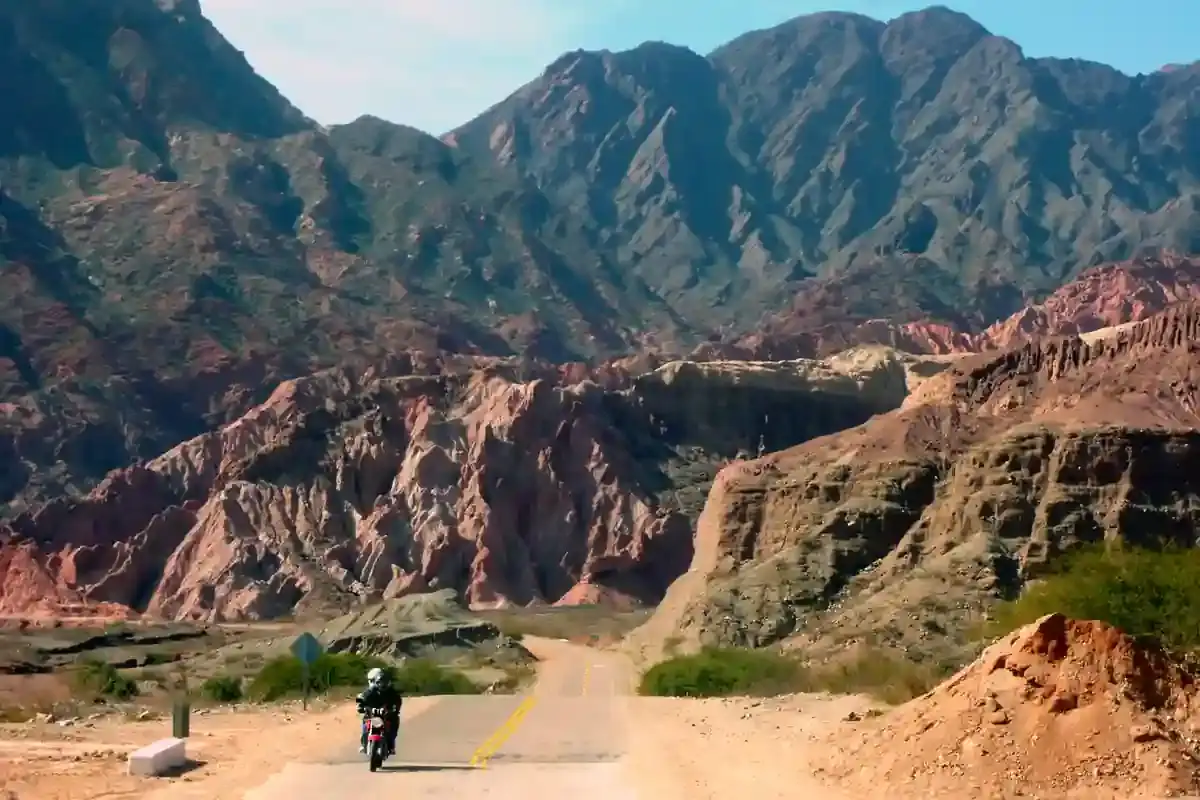
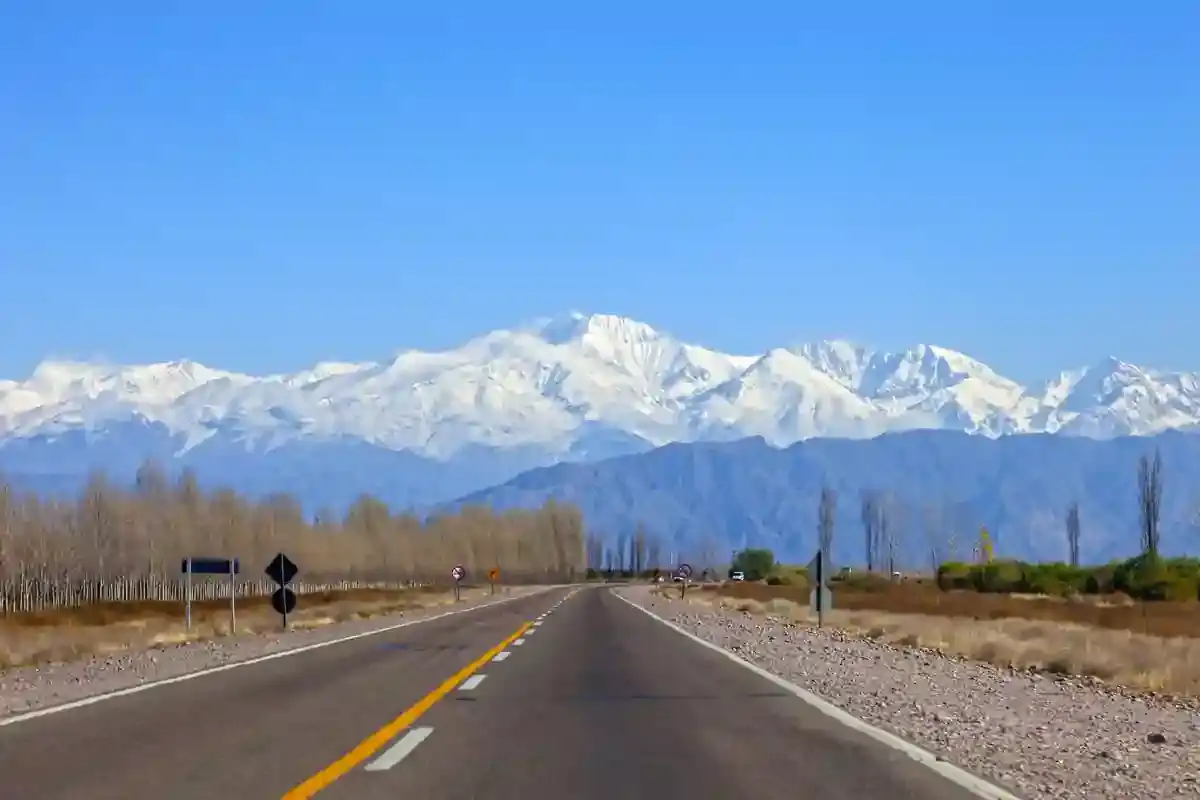 The Andes ahead on the Mendoza approach: the daily rhythm of an Argentina trip is built around days like this one.
Daily planning once you're riding
The daily rhythm that works here
Riding in Argentina rewards an early start more than almost anywhere we’ve toured. Leave by 8:30, arrive by 16:00 is the Patagonian rhythm: the wind builds through the afternoon, the light gets harsh, and the fuel stations and hosterías in small towns keep small-town hours. The early rhythm also banks daylight for the day a gravel section, a photo hour, or a closed pass rewrites the plan.
Run the fuel and weather check as a two-minute ritual every evening: tomorrow’s distance, the fuel stops on it, the wind forecast, and the booking situation at the destination. South of Bariloche, top up at every working pump regardless of the gauge. Wind is a fuel multiplier in Patagonia, and our tips for navigating the Andes safely cover how crosswind, altitude, and afternoon weather change both range and riding technique.
When the plan changes
It will. A pass closes, a tanker is late, a forecast turns. The planning structure you built exists so that changes cost a day, not the trip: anchored bookings only at the true bottlenecks, slack days in the schedule, cash for the town the cards don’t reach, and a route measured in riding days that can absorb a 250 km detour. Hold the route skeleton loosely and protect the rest days; they’re the shock absorbers.
Know your bailout options before you need them. Every Patagonian route has a pavement alternative to most gravel sections, a bus-and-truck option for a broken bike, and a domestic airport within a day’s ride. Writing the bailouts into the route notes at planning time takes 20 minutes and converts a potential crisis into an annoying Tuesday.
Conclusion
The timeline at a glance
Planning a motorcycle trip to Argentina compresses into one sequence. A year out: region, month, and time off. Six months out: the bike reserved and the route shaped in riding days. Three months out: documents, insurance, IDP, and the bottleneck bookings. One month out: money, offline maps, and connectivity. The final week: card flags, luggage weight, and a buffer day on the front. Then a daily rhythm of early starts, evening fuel checks, and protected rest days.
The deeper pattern of Argentina motorcycle trip planning is that every stage closes the questions the next one needs. You can’t book lodging until the route has a shape; the route can’t have a shape until the bike and month are fixed; and none of the daily flexibility works without the paperwork and money layers being boring and solved. That’s the whole method: make the foundations dull so the riding can be the interesting part.
None of this is meant to make riding in Argentina sound complicated. Thousands of foreign riders cross the country every season, on rentals and on their own bikes, and the 2026 version of the trip is administratively the easiest it’s been in a decade: visa-free entry for most, one converged exchange rate, cards that just work, and a TVIP that’s free at the border. The planning load is real but front-loaded, which is exactly where you want it.
Planning your trip
If you’d rather pressure-test your plan than build it alone, the 5 reasons to join a guided motorcycle tour in Argentina and Chile post is an honest look at what a guided format does and doesn’t solve. For riders who want the logistics handled end to end, our Patagonia motorcycle tours and Argentina-Chile motorcycle tours run exactly the routes this guide describes, with the bikes, bookings, fuel logistics, and backup vehicle already in place.
And if your dates or route don’t fit a scheduled departure, get in touch. We build custom itineraries around your dates, and we’re happy to tell you honestly which months fit which regions, which sections we’d ride, and which we’d skip for the year you’re traveling.