Introduction
The Andes are not forgiving to the wrong bike. Passes over 4,000 m (13,100 ft), 100 km (62 mi) stretches of ripio on the Carretera Austral and south of El Calafate, sustained wind, fuel gaps pushing 300 km (186 mi), and a dealer network that thins out fast south of Santiago or Buenos Aires mean every kilogram on the bike costs you something. Riders who show up on the wrong machine end up either underbiking the hard days or overbiking the long ones, and neither makes for a trip you want to repeat.
This is a 2026 comparison of seven adventure motorcycles that make sense for riding the Andes, with an honest note on why bikes bigger than the middleweight class are a bad fit here. The goal is to help you pick based on what you’ll actually encounter on Ruta 40, the Carretera Austral, and the classic loop through Bariloche, El Chaltén, and Torres del Paine. Weights are wet where the manufacturer publishes them, dry where they don’t, marked either way. Prices are approximate 2026 US MSRP.
What matters for an Andes bike
Weight is the dominant variable
The single strongest predictor of whether a bike will work for a long Andes trip is unladen weight. The middleweight class, parallel twins roughly 650 to 900 cc, sits in the 185 to 230 kg (408 to 507 lb) band. Above that, you’re in territory where a fallen bike becomes a two-rider problem, a slow hill climb on loose gravel turns into a pushing match, and the back of your neck at the end of a 12-hour day stops being funny.
This is not abstract. On a Ruta 40 stretch between Perito Moreno and El Chaltén, a 195 kg (430 lb) bike is still something you can wrestle solo after a low-side. A 240 kg (529 lb) bike is not, and the chain of small dropping incidents that happen on loose gravel at day six becomes the biggest source of fatigue and risk. Our guide on navigating the Andes safely covers those real-world conditions in more detail.
Weight also multiplies with load. A 220 kg bike with two aluminum panniers, a top case, tools, spares, and two weeks of gear lands at 270 to 290 kg (595 to 639 lb) fueled up. That’s the weight you’re actually riding, and it’s what matters when the back wheel starts stepping out on damp ripio south of Coyhaique.
Suspension, wheels, and ground clearance
The second filter is basic dirt-bike geometry: a 21-inch front wheel, long-travel suspension (220 mm / 8.7 in or more for serious gravel), and meaningful ground clearance (230 mm / 9 in and up). A 19-inch front with a 17-inch rear, the setup on most road-focused adventure bikes, limits off-road tire choice, makes the front tuck more easily in sand, and fails in the kind of potholes you meet on older stretches of Ruta 40.
Suspension travel determines how much abuse the bike can take before bottoming out. Short-travel touring bikes (around 170 mm / 6.7 in) are fine for paved and light gravel but punish you on continuous washboard. The bikes below range from 200 mm (shortest) to 240 mm (longest). The difference is tangible within the first hour on a rough road.
The off-road specialists
Yamaha Ténéré 700
If one bike has become the default middleweight benchmark over the last five years, it’s the Ténéré. The 689 cc parallel twin makes a modest 72 hp, but the combination of roughly 189 kg (417 lb) dry weight, 21/18 wheels, 210 mm (8.3 in) of travel, and a transparent chassis makes it the bike all the others in this class are judged against. It is the easiest to pick up off the ground, the easiest to ride slowly through technical sections, and the easiest to fix if something goes wrong.
Trade-offs are a basic dashboard, one power mode, and a 34.4-inch seat that is tall for shorter riders. The 16-liter (4.2 gal) tank gives about 300 km (186 mi) of range, adequate but not generous. US MSRP is around $10,500. For riders who want a bike that disappears under them and does the job, it is still the first bike to consider.
KTM 890 Adventure R
The 890 Adventure R is the bike to buy if you’re a stronger off-road rider and the technical sections are what you’re going to the Andes for. The 889 cc parallel twin makes about 105 hp, the WP XPLOR 48 fork delivers 240 mm (9.4 in) of travel, and the chassis is sharp in a way that rewards good technique and punishes laziness.
Electronics are a full TFT dash, multiple riding modes, lean-angle-sensitive ABS and traction control, and a fuel tank that wraps low around the engine for strong mass centralization. The bike comes alive on loose surfaces in a way the Ténéré and Transalp simply don’t.
Trade-offs are price (around $15,500 US MSRP), more frequent valve check intervals than the Yamaha or Honda, and a service network that thins out once you leave Santiago or Buenos Aires. Dry weight is about 196 kg (432 lb), which is light for the power but you do feel the extra seven kilograms over the Ténéré on very tight switchbacks. For the sharpest off-road-capable adventure bike in the class, though, this is the answer.
Aprilia Tuareg 660
The Tuareg 660 is the surprise of the class. Aprilia came late to the middleweight adventure game and landed a bike with the best chassis feel of any of these, a KYB fork with 240 mm (9.4 in) of travel, honest 21/18 wheels, and a 659 cc parallel twin that makes about 80 hp with a great midrange. Wet weight is roughly 204 kg (450 lb) with an 18-liter (4.7 gal) tank, and it feels lighter than it is.
The catch is South American service network. Aprilia has a smaller presencia in Argentina and Chile than KTM, Yamaha, or Honda, so parts availability in a pinch is a real consideration. US MSRP is around $12,500. If you’re shipping your own bike or buying from overseas, the Tuareg is one of the most rewarding picks on this list.
The all-round middleweights
Honda XL750 Transalp
The Transalp is the workhorse. The 755 cc parallel twin makes about 91 hp, 21/18 wheels handle most of what the Andes throws at you, and Honda reliability needs no explanation. Wet weight is about 208 kg (459 lb), and the 16.9-liter (4.5 gal) tank gives strong range. Suspension travel is on the short end for this list (200 mm / 7.9 in front), so the Transalp is at a mild disadvantage on the most abused ripio, but it handles 90 percent of Andes riding without complaint.
The other advantage is dealer network. Honda has a wider service footprint in Argentina and Chile than any other brand here, and parts availability is consistently the strongest. US MSRP is around $10,000, which makes it the best value-per-capability bike in the comparison. For a first Patagonia trip on an owned bike, it’s hard to argue against.
Triumph Tiger 900 Rally Pro
The Tiger 900 Rally Pro brings the only triple-cylinder engine to the fight. The 888 cc triple makes about 108 hp, the 21/18 wheel setup and 240 mm (9.4 in) of travel put it in serious adventure territory, and the full electronics package (quickshifter, cornering ABS, six riding modes) makes it a comfortable long-distance tool.
The triple’s character is worth mentioning on its own. Power delivery is smoother and more linear than a parallel twin, which is genuinely pleasant on a 400 km (249 mi) touring day. For a rider who crosses a lot of paved distance between off-road sections, the triple is a quality-of-life upgrade over the twins in this list.
Trade-offs are weight (wet weight roughly 228 kg / 502 lb, the heaviest of the sharp-handling bikes here) and price (around $17,000 US MSRP). Our full Triumph Tiger 900 Rally Pro review goes into more detail on ride and maintenance. The Rally Pro is best understood as a bike for riders who want long-distance touring comfort and genuine off-road capability, and are willing to pay for both.
BMW F 900 GS
The F 900 GS replaced the F 850 GS in 2024 and came out lighter and sharper. The 895 cc parallel twin makes about 105 hp, the chassis shed weight through revised frame and suspension, and the 21-inch front wheel and longer travel make it a competent off-road machine. Wet weight is around 219 kg (483 lb). Electronics are the full BMW package: riding modes, cornering ABS, connected dash.
The one persistent quibble is the 17-inch rear wheel. It’s a concession to road manners that costs tire selection and toughness compared to the 18-inch rear on the KTM, Aprilia, Yamaha, Honda, and Triumph. For riders who do 70 percent pavement and 30 percent moderate off-road, the F 900 GS makes sense. For planning technical off-road, that 17-inch rear is a real trade-off. US MSRP is around $14,500.
CFMOTO 800MT Explore
The Explore trim of the 800MT is where CFMOTO gets interesante for the Andes. The 799 cc parallel twin is KTM-derived (the LC8c family), power is around 95 hp, and the Explore spec adds 21/18 wheels, longer-travel suspension, and skid protection. Wet weight is around 231 kg (509 lb), which is on the heavy end of the class. What you get in exchange is a bike with full electronics, a strong build, and a price that’s hard to argue with: roughly $7,500 US MSRP, three to nine thousand dollars below any other bike on this list.
The trade-offs are predictable. Dealer network in Argentina and Chile is uneven, long-term reliability data is thinner than for established brands, and resale value is lower if you ship a bike and plan to sell it at the end of the trip. Our CFMOTO 800MT Explore review goes deeper on where it fits, and our broader take on Chinese motorcycles is worth reading alongside.
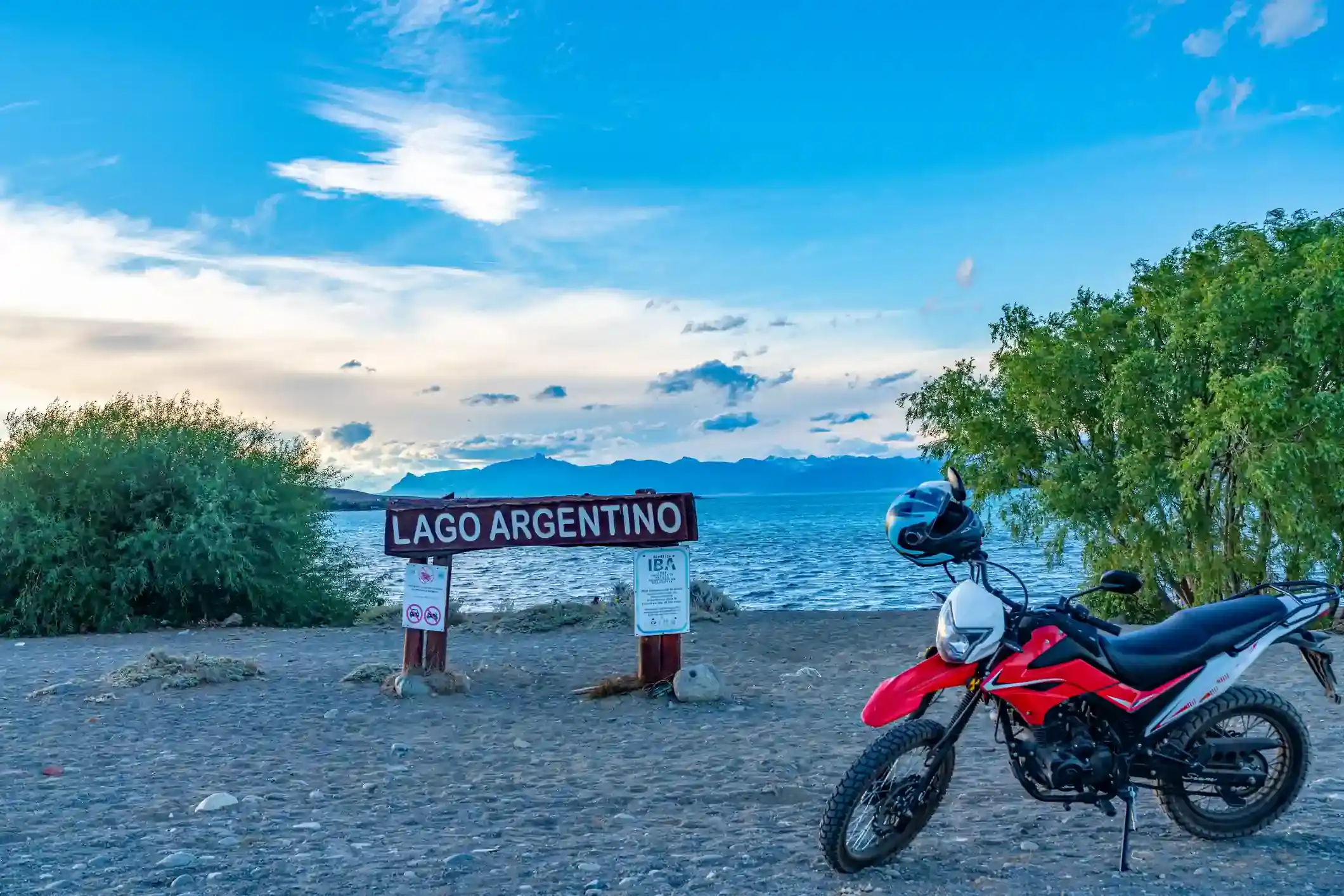 Lago Argentino shoreline, El Calafate, Santa Cruz province.
Why not go bigger
The weight problem
The big adventure bikes, the R 1300 GS, KTM 1390 Super Adventure, Tiger 1200 Rally Pro, Africa Twin Adventure Sports, all weigh 240 kg (529 lb) or more wet, before fuel and luggage. Some of them are spectacular pavement machines. None is the right tool for the Andes off-road window.
The math is simple. A 260 kg (573 lb) bike fully fueled, plus 40 kg (88 lb) of luggage and gear, is 300 kg (661 lb) on the sidestand. When that bike goes down in deep gravel or muddy ripio, you are not picking it up alone, and you are not picking it up quickly. A 200 kg bike with the same luggage lands at 240 kg, still heavy but recoverable with one rider and good technique. The difference between recoverable and not-recoverable on day eight is the difference between a story and a disaster.
What else you lose on the big bikes
Beyond weight, the 1200+ class typically comes with shorter off-road suspension travel (around 190 mm / 7.5 in on the base R 1300 GS), more rider aids that depend on electricity and sometimes cell data to function correctly, and service intervals that are harder to meet outside a major city. These bikes are built for transcontinental pavement and light unpaved roads, not for the Carretera Austral in April.
Our top three off-road adventure motorcycles post makes a similar argument. For a mostly-pavement Patagonia trip on an owned bike, the big adventure platforms can work. For the full Andes experience, the mix of pavement, ripio, border crossings, and deep off-road side trips, the middleweight class is the honest answer.
Conclusion
Quick picks by rider
If you’re an experienced off-road rider going primarily for the dirt, the KTM 890 Adventure R is the sharpest tool. If you want the same capability with a different flavor and you’re willing to work a tighter service network, the Aprilia Tuareg 660 is the most rewarding ride.
If you’re a long-distance tourer who wants off-road capability as a strong backup, the Triumph Tiger 900 Rally Pro or the BMW F 900 GS are the strongest picks. If you want the lowest total cost of ownership and bulletproof reliability, the Honda XL750 Transalp is the right answer. If you want the default benchmark that just works, the Yamaha Ténéré 700 is still the first bike to consider. And if your budget is the binding constraint, the CFMOTO 800MT Explore deserves a serious look.
The single most common mistake first-time Patagonia riders make is buying more bike than they need. Ruta 40 and the Carretera Austral don’t reward horsepower, and they don’t reward plush seats. They reward weight management, honest suspension, and tires that can handle the rough. Any of the seven bikes above can do the trip. None of the 1200/1300 class should, unless you plan to stay on pavement the entire time. For a deeper dive into price-per-capability, our mid-range adventure bike roundup works through the value math in more detail.
Final thoughts
The right adventure bike for the Andes is not the biggest bike you can afford. It’s the bike you can still stand up on day ten, the bike that handles the gravel without fighting you, and the bike whose parts you can realistically source between Santiago and Ushuaia. That set of constraints rules out most of the 1200+ class and rules in the seven middleweights above. Picking between them is a question of your riding style, budget, and home service network.
If you want to see how these bikes actually perform on the route, take a look at our Andes Crossing expedition. All of our rental bikes sit inside the class we recommend here. Or get in touch if you want help thinking through which bike makes sense for your specific trip. We usually reply within a day.