The best middleweight adventure bike for a long trip through Argentina and Chile is, by our scoring, the Honda XL750 Transalp, with the KTM 890 Adventure R and the Honda Africa Twin a few tenths behind and the Yamaha Ténéré 700 fourth. That is not the order most lists give you, and the difference is the method. We scored ten bikes, 2025 and 2026 model years, on eight weighted criteria that matter on a ten-day ride here: weight, gravel ability, range against the real fuel gaps in our route atlas, highway stability, two-up suitability, dealer support counted from the official locators in Argentina and Chile, running cost from the service schedules, and price. Every score is in a table below, so you can reweight it for your own trip and get a different, equally honest answer.
The job matters. We are not ranking for a weekend on trails or a commute. We are ranking for the kind of riding our tours across Argentina and Chile are made of: long paved days, passes above 2,000 m, a quarter of the route on gravel, luggage for two weeks and, often, two people sharing one motorcycle. Change the job and the order changes; the last section shows by how much.
The ranking
| Rank | Bike (model year) | Score / 10 | Why it lands here |
|---|---|---|---|
| 1 | Honda XL750 Transalp (2026) | 8.0 | Cheapest, light, 272 km of range in a headwind, and the biggest dealer network on both sides of the Andes |
| 2 | KTM 890 Adventure R (2026) | 7.8 | Best gravel bike, longest range, longest service intervals; loses on price and a thinner network |
| 3 | Honda CRF1100L Africa Twin (2025) | 7.6 | Heaviest here but the best two-up and highway bike with real 230 mm of travel and Honda’s network |
| 4 | Yamaha Ténéré 700 (2026) | 7.4 | Light, cheap, simple, with the widest dealer network here; a 16 l tank and an 875 mm seat cost it points on range and two-up |
| 5 | Aprilia Tuareg 660 (2026) | 7.3 | Lightest, most frugal, 240 mm of travel at both ends; small network and no comfort for a passenger |
| 6 | Suzuki V-Strom 800DE (2026) | 7.0 | 20 l tank, 220 mm of travel and USD 11,799; the weight of an Africa Twin with 83 hp |
| 7 | Triumph Tiger 900 Rally Pro (2026) | 7.0 | Best two-up and highway score with the KTM’s travel; the most expensive bike here and 228 kg |
| 8 | BMW F 900 GS (2026) | 6.6 | 105 hp and 219 kg undone by a 14.5 l tank: 228 km in a headwind, less than the Bajo Caracoles gap |
| 9 | CFMoto 800MT Explore (2025) | 6.2 | Fully equipped for the price, but 19-inch front, 160 / 150 mm of travel and 231 kg |
| 10 | Ducati Multistrada V2 (2025) | 5.9 | The fastest road bike in adventure clothes: 170 mm of travel, road tires, fewest dealers |
Three columns decide most of this: weight, suspension and tank. Power matters less than people think once a bike has 70 hp at sea level, and we show below what 70 hp becomes at 4,000 m. All ten bikes except the V-Strom are in our adventure bike comparator, where you can sort any column and put three side by side.
How we scored, so you can redo it
Each bike gets a score from 0 to 10 on eight criteria. The total is the weighted average. The weights are ours and they are arguable; that is the point of showing them.
| Criterion | Weight | How the score is calculated |
|---|---|---|
| Weight | 15 % | Linear: 10 for the lightest (204 kg), 4 for the heaviest (231 kg), wet weight as published |
| Gravel suspension and geometry | 15 % | Up to 6 points for average travel (6 at 240 mm, 0 at 140 mm) plus 4 for a 21-inch front wheel, 1 for a 19-inch |
| Range vs the longest fuel gaps | 15 % | Range on 90 % of the tank at the manufacturer’s consumption plus 30 % (gravel and headwind). 10 at 320 km, 0 at 150 km |
| Highway comfort and wind stability | 10 % | Power (4 points at 100 hp or more, 3 at 85 to 99, 2 below), front wheel (2 for a 19-inch, 1 for a 21), weight (2 at 220 kg or more, 1 at 210 to 219, 0 below), out of 8 |
| Two-up and Shared Ride | 10 % | Seat height (3 at 850 mm or less, 2 up to 870, 1 above), power (3 at 100 hp, 2 at 85, 1 below), weight (2 at 220 kg or more, 1 at 210), plus 2 if heated grips and cruise control are standard |
| Dealer support in Argentina and Chile | 15 % | Official locator counts, both countries added: 10 at 100 or more points, 8 at 30 to 99, 6 at 15 to 29, 4 at 5 to 14, 2 below 5 |
| Running cost | 10 % | Valve check interval (4 at 30,000 km, 3 at 24,000, 2 at 20,000), oil interval (2 at 12,000 km or more, 1.5 at 10,000, 1 at 6,000, 0.5 at 5,000), tire sizes (3 for 90/90-21 and 150/70-18, 2 for a 150/70-17 rear, 1 for road sizes), consumption (1 at 4.4 l/100 km or less, else 0.5) |
| Price | 10 % | Linear on US list price: 10 for the cheapest (USD 10,199), 4 for the most expensive (USD 17,595) |
Two things are deliberately missing. Electronics do not score, because all ten bikes now have ride modes and switchable traction control, and we do not think the differences above that decide a ten-day trip. And reliability does not score, because we have no defensible way to put a number on it across ten bikes; what we can measure, service intervals and dealer density, is in running cost and dealer support.
The field, by the numbers
The figures are the manufacturers’, for the model year in the first column, with the source linked the first time it appears. Prices are US list prices before destination charges.
| Bike | MY | cc | hp | Wet weight | Seat | Tank | Travel F / R | Wheels | US price |
|---|---|---|---|---|---|---|---|---|---|
| Yamaha Ténéré 700 | 2026 | 689 | 72 | 208 kg | 875 mm | 16 l | 210 / 200 mm | 21 / 18 | USD 10,999 |
| KTM 890 Adventure R | 2026 | 889 | 105 | 215 kg (200 without fuel) | 880 mm | 20 l | 240 / 240 mm | 21 / 18 | USD 16,299 |
| Honda XL750 Transalp | 2026 | 755 | 91 | 212 kg | 850 mm | 16.9 l | 200 / 190 mm | 21 / 18 | USD 10,199 |
| Aprilia Tuareg 660 | 2026 | 659 | 80 | 204 kg | 860 mm | 18 l | 240 / 240 mm | 21 / 18 | USD 12,499 |
| Triumph Tiger 900 Rally Pro | 2026 | 888 | 106.5 | 228 kg | 860 / 880 mm | 20 l | 240 / 230 mm | 21 / 17 | USD 17,595 |
| Honda CRF1100L Africa Twin | 2025 | 1,084 | 102 | 231 kg | 850 / 870 mm | 18.8 l | 230 / 220 mm | 21 / 18 | USD 14,799 |
| BMW F 900 GS | 2026 | 895 | 105 | 219 kg | 870 mm | 14.5 l | 230 / 215 mm | 21 / 17 | USD 14,275 |
| CFMoto 800MT Explore (Ibex 800 E in the US) | 2025 | 799 | 94 | 231 kg | 825 mm | 19 l | 160 / 150 mm | 19 / 17 | USD 10,299 |
| Ducati Multistrada V2 | 2025 | 890 | 115 | 199 kg without fuel (about 213 kg full) | 830 / 850 mm | 19 l | 170 / 170 mm | 19 / 17 | USD 15,995 |
| Suzuki V-Strom 800DE | 2026 | 776 | 83 | 230 kg | 855 mm | 20 l | 220 / 220 mm | 21 / 17 | USD 11,799 |
Notes on the numbers that trip people up. The Ténéré’s 2025 update brought ride-by-wire with two throttle maps, switchable traction control, three ABS modes and a 6.3-inch vertical TFT, and the US wet weight went to 459 lb, 208 kg (Cycle News). The Transalp gained Honda’s E-Clutch, fully adjustable suspension and a skid plate for 2026, which added 5 lb and USD 200 over the 2025 bike. The Tiger 900’s 2024 engine update took it from 93.9 to 106.5 hp (RevZilla); older guides still print 94. The Multistrada V2 is a different motorcycle since 2025: a new 890 cc V2 with 115 hp instead of the 937 cc at 113, and 39.7 lb lighter. The KTM’s 2025 facelift changed graphics, made the connectivity unit standard and doubled the warranty to 24 months; suspension and electronics were untouched (ADV Pulse). The BMW’s 2026 US price is from BMW Motorrad USA’s model-year update. The CFMoto is sold in the US as the Ibex 800 E, at the price in Dirt Bike Magazine’s 2026 buyer’s guide; its European sheet quotes 91 hp, where US listings say 95, and CFMoto does not publish suspension travel for the Explore, which 1000PS lists as 140 mm front and 145 mm rear. The V-Strom’s 83 hp is the figure in Lexham’s December 2025 list; Suzuki’s own US page does not print power.
Who is in, who is out, and why
The nine bikes in our comparator were chosen in 2025. For 2026 we added one and left several out, and here is the reasoning, because the exclusions are where most rankings cheat.
In: Suzuki V-Strom 800DE. It appears on every serious 2026 list and it earns it: a 20 l tank, 220 mm of fully adjustable travel at both ends, 220 mm of ground clearance, a 21-inch front, traction control with a Gravel mode and a rear ABS that switches off, for USD 11,799. Its problem is 230 kg, which is Africa Twin weight with 83 hp.
Out: Ducati DesertX. A 2026 DesertX lists at USD 16,995 with 110 hp and 222 kg ready to ride (1000PS’s four-bike 2026 test). It would place near the KTM on gravel and below it on price and dealers. We left it out because Ducati’s network in Argentina and Chile is the thinnest of any brand here, and one Ducati in the table already shows what that costs.
Out: Husqvarna Norden 901. Same 889 cc engine, frame and electronics as the KTM 890 Adventure, 217.5 kg in the 1000PS test, sold through the same importer in Argentina. It would score within a tenth of the KTM and tell you nothing new.
Out: BMW F 800 GS, KTM 790 Adventure. Both are the cheaper, lower-spec version of a bike already in the table: the F 800 GS has 87 hp, a 19-inch front and a 15 l tank; the 790 Adventure has 200 mm of travel and a 70 kW engine. If your budget stops at USD 11,000 they belong in the conversation, and the Transalp and Ténéré sections cover that case.
Out: Kawasaki KLE 500, CFMoto 450MT, Kove 450 Rally. Under 500 cc. The 450MT weighs 175 kg and costs half the price of most bikes here, which makes it the right answer for a different question. Forty-one hp at sea level is 28 hp at the Cuesta de Lipán, and that is not a two-up bike.
Out: MV Agusta Enduro Veloce, Moto Guzzi Stelvio. Over USD 16,000, 19-inch front on the Guzzi, and neither brand has a network south of Buenos Aires that we could count.
Out: the CFMoto 800MT-X and the Ténéré 700 World Raid. Both are variants of bikes already in the table and both fix the exact weakness we score: the 800MT-X has a 21-inch front, 230 mm of travel and a 22.5 l tank at 220 kg (1000PS), and the World Raid carries 23 l for USD 12,999 at 220 kg. We could not verify a US list price for the 800MT-X. If you are choosing a CFMoto for gravel, it is the one; the Explore is the road bike.
The scores, criterion by criterion
| Bike | Weight | Gravel | Range | Highway | Two-up | Dealers | Running cost | Price | Total |
|---|---|---|---|---|---|---|---|---|---|
| Honda XL750 Transalp | 8.2 | 7.3 | 7.2 | 6.2 | 6.0 | 10.0 | 9.0 | 10.0 | 8.03 |
| KTM 890 Adventure R | 7.6 | 10.0 | 9.7 | 7.5 | 5.0 | 6.0 † | 10.0 | 5.1 | 7.75 |
| Honda Africa Twin | 4.0 | 9.1 | 6.8 | 8.8 | 8.0 | 10.0 | 8.5 | 6.3 | 7.64 |
| Yamaha Ténéré 700 | 9.1 | 7.9 | 6.3 | 3.8 | 2.0 | 10.0 | 9.0 | 9.4 | 7.42 |
| Aprilia Tuareg 660 | 10.0 | 10.0 | 9.5 | 3.8 | 3.0 | 4.0 † | 7.5 | 8.1 | 7.26 |
| Suzuki V-Strom 800DE | 4.2 | 8.8 | 9.7 | 6.2 | 5.0 | 6.0 † | 7.0 | 8.7 | 7.00 |
| Triumph Tiger 900 Rally Pro | 4.7 | 9.7 | 6.8 | 8.8 | 9.0 | 6.0 | 7.0 | 4.0 | 6.96 |
| BMW F 900 GS | 6.7 | 8.9 | 4.6 | 7.5 | 6.0 | 6.0 | 6.5 | 6.7 | 6.60 |
| CFMoto 800MT Explore | 4.0 | 1.1 | 5.2 | 8.8 | 9.0 | 8.0 † | 7.0 | 9.9 | 6.21 |
| Ducati Multistrada V2 | 8.0 | 2.8 | 5.2 | 8.8 | 7.0 | 4.0 † | 7.5 | 5.3 | 5.86 |
† Dealer score partly provisional: see the dealer table for what was counted and what was not.
Read the table across and the ranking explains itself. The Transalp wins nothing outright and loses nothing badly: it is never below 6 and it takes a 10 on the two criteria with the most certain data, price and dealers. The KTM takes three 10s and pays for them in price. The Tuareg has the best hardware score of any bike here, 10 on weight and gravel and 9.5 on range, and drops to fifth on the two criteria that have nothing to do with the bike: who can fix it, and who sits behind you. The Ténéré, which tops most lists, is fourth because the 16 l tank and the 875 mm seat are scored instead of forgiven.
Power at altitude: what 4,895 m does to every bike here
Naturally aspirated engines lose power with thin air. The rule of thumb is 3 % per 300 m of elevation (Automotive World); Honda’s own small-engine manuals put it at about 3.5 % per 300 m even with the mixture corrected (Honda GC160 owner’s manual). Fuel injection keeps the mixture right, but it cannot put oxygen back in the cylinder. Using 3 % per 300 m, here is what each bike has left at the heights our tours actually reach: the Quebrada de Humahuaca tops at 2,959 m, the Cuesta del Obispo at 3,353 m, the Cuesta de Lipán at 4,192 m, and the Abra del Acay sign says 4,895 m.
| Bike | Sea level | 2,000 m | 3,000 m | 4,000 m | 4,895 m (Acay) |
|---|---|---|---|---|---|
| Ducati Multistrada V2 | 115 hp | 92 | 80 | 69 | 59 |
| Triumph Tiger 900 Rally Pro | 106 hp | 85 | 74 | 64 | 54 |
| KTM 890 Adventure R | 105 hp | 84 | 74 | 63 | 54 |
| BMW F 900 GS | 105 hp | 84 | 74 | 63 | 54 |
| Honda Africa Twin | 102 hp | 82 | 71 | 61 | 52 |
| Honda XL750 Transalp | 91 hp | 73 | 64 | 55 | 46 |
| CFMoto 800MT Explore | 94 hp | 75 | 65 | 56 | 48 |
| Suzuki V-Strom 800DE | 83 hp | 66 | 58 | 50 | 42 |
| Aprilia Tuareg 660 | 80 hp | 64 | 56 | 48 | 41 |
| Yamaha Ténéré 700 | 72 hp | 58 | 50 | 43 | 37 |
Two readings. First, on the Acay every bike here is a 37 to 59 hp motorcycle, and the gap between the Ténéré and the KTM, 33 hp at sea level, shrinks to 17. Second, the number that matters at altitude is power per kilogram with two riders and luggage on board. A Ténéré with two 80 kg riders and 30 kg of luggage is about 400 kg rolling at 37 hp on the Acay climb: 9.3 hp per 100 kg. The same load on the KTM is 54 hp for 405 kg, 13.3 per 100 kg. That is why, for the Andean Highlands specifically, the three 100 hp bikes move up and the two smallest engines move down, whatever their sea-level charm.
Range against the real gaps
Fuel gaps are the one spec most rankings skip and the one that strands people. The longest stretches without a pump on the roads we ride, from the route atlas built on OpenStreetMap data: 232 km between Gobernador Costa and Río Mayo on Ruta 40 from Esquel to Perito Moreno, 225 km from Bajo Caracoles to Gobernador Gregores on the Perito Moreno segment, 208 km from El Chaltén to El Calafate, 175 km on the Gobernador Gregores to El Chaltén gravel, 198 km from Purmamarca to San Antonio de los Cobres over Lipán and the Salinas Grandes, 143 km over the Abra del Acay, 135 km on the Hua Hum crossing with 113 km of it gravel, and 119 km over the Cuesta del Obispo.
Range is computed on 90 % of the tank (you never run a bike dry on purpose) at the manufacturer’s published consumption, then at that figure plus 15 % for mixed surfaces and plus 30 % for gravel with a Patagonian headwind, the same factors the fuel range calculator uses. Consumption figures are WMTC or manufacturer combined: Ténéré 4.3 l/100 km (Yamaha Europe data), KTM 4.4 (1000PS, consistent with KTM’s 103 g/km of CO2), Transalp 4.3 (Honda Europe), Tuareg 4.0 (Aprilia), Tiger 5.2 (Triumph’s US figure of 45 mpg; the European sheet says 4.7), Africa Twin 4.9 (Honda UK, 20.5 km/l), BMW 4.4 (BMW), Multistrada V2 5.5 (1000PS homologation data), V-Strom 4.4 (Suzuki, 22.7 km/l). CFMoto publishes no figure; we assume 5.5 l/100 km, the same as the Ducati with the same tank, and flag it.
| Bike | Usable fuel | Range, published | Range, +15 % | Range, +30 % | Río Mayo gap, 232 km | Bajo Caracoles, 225 km | Lipán, 198 km (+15 %) |
|---|---|---|---|---|---|---|---|
| KTM 890 Adventure R | 18.0 l | 409 km | 356 km | 315 km | 1.36× | 1.40× | 1.80× |
| Suzuki V-Strom 800DE | 18.0 l | 409 km | 356 km | 315 km | 1.36× | 1.40× | 1.80× |
| Aprilia Tuareg 660 | 16.2 l | 405 km | 352 km | 312 km | 1.34× | 1.38× | 1.78× |
| Honda XL750 Transalp | 15.2 l | 354 km | 308 km | 272 km | 1.17× | 1.21× | 1.55× |
| Triumph Tiger 900 Rally Pro | 18.0 l | 346 km | 301 km | 266 km | 1.15× | 1.18× | 1.52× |
| Honda Africa Twin | 16.9 l | 345 km | 300 km | 266 km | 1.14× | 1.18× | 1.52× |
| Yamaha Ténéré 700 | 14.4 l | 335 km | 291 km | 258 km | 1.11× | 1.14× | 1.47× |
| CFMoto 800MT Explore * | 17.1 l | 311 km | 270 km | 239 km | 1.03× | 1.06× | 1.37× |
| Ducati Multistrada V2 | 17.1 l | 311 km | 270 km | 239 km | 1.03× | 1.06× | 1.37× |
| BMW F 900 GS | 13.1 l | 297 km | 258 km | 228 km | 0.98× | 1.01× | 1.30× |
* Assumed consumption.
The last three columns are the margin: range divided by the gap. Anything under 1.2 is a coin toss, because the atlas gap is measured pump to pump and you will not arrive at the first pump full. On the Río Mayo stretch in December, when the atlas climate data for that segment shows gusts over 60 km/h on 14 days of the month, the Ténéré’s 1.11× means riding at 90 km/h and hoping; the BMW’s 0.98× means a fuel bladder or a detour to Sarmiento, no exceptions; the Ducati’s and the CFMoto’s 1.03× are the same problem with more weight. North of Río Mayo none of this matters: the Bariloche to Esquel segment has 21 stations and a longest gap of 120 km, which even the BMW clears at 1.9×. Every bike clears every Andean Highlands gap at the +15 % factor, including Lipán at 198 km, but note that the Acay’s 143 km include 117 km of gravel and a 4,895 m climb, so the +30 % column is the honest one there too: the BMW at 228 km has 1.6× and the KTM 2.2×.
Dealer support: what the official locators say
Counted on October 30, 2026, from each brand’s dealer locator in Argentina and Chile, both countries added. Where a locator loads from a map and does not list dealers, or the site blocked the check, we say so and the score is marked provisional; we did not guess a count.
| Brand | Argentina | Chile | Total used | Score | Basis |
|---|---|---|---|---|---|
| Honda | 161 listings, dealers plus official workshops and parts counters, from Ushuaia to Tartagal, including Bariloche and Neuquén (locator) | 8, all in Santiago (locator) | 169 | 10 | Verified, both countries |
| Yamaha | 187 dealers selling motorcycles, 175 of them with a workshop, from Río Grande to Salta and Jujuy, including Bariloche and Neuquén (locator, counted from its data feed) | 33 motorcycle dealers, Calama to Punta Arenas, with Osorno and Puerto Montt (locator) | 220 | 10 | Verified, both countries |
| CFMoto | “More than 15” dealers per the importer in 2023 (La Moto); the locator is map-only | 15 distributors plus 2 brand stores, Antofagasta to Punta Arenas, including Osorno (locator) | 32 | 8 † | Chile verified; Argentina from 2023 press |
| Triumph | 11 official dealers after the Puerto Madero opening in August 2026, including Mendoza and Ushuaia (La Moto); the locator is map-only | 5 points, Santiago (2), Viña del Mar, Concepción, Osorno (locator) | 16 | 6 | Chile verified; Argentina from the importer’s announcement |
| KTM | 24 official dealers on the importer’s list, including Bariloche, Neuquén, Comodoro Rivadavia and Salta (list) | Locator is map-only; not counted | 24 | 6 | Argentina verified; Chile not counted, and it would take more than 6 Chilean points to change the score |
| Suzuki | Site unreachable during the check | Site blocked the check | none | 6 † | Estimate: Suzuki resumed local production in June 2026 (iProfesional); no count |
| Aprilia | 14 Motoplex stores: Buenos Aires city and province (8), Rosario, Córdoba, Mendoza, Salta, Neuquén, Resistencia (locator); Aprilia sells through Motoplex (Mercado) | Site blocked the check | 14 | 4 † | Argentina verified via Motoplex; nothing verified in Chile |
| BMW | 13 motorcycle points in 11 cities, Neuquén the southernmost, read on November 2, 2026 through BMW’s dealer database (our F 900 GS vs 890 note has the method) | 5: Santiago (2), Viña del Mar, La Serena (locator) and Concepción in the global locator | 18 | 6 | Verified, both countries |
| Ducati | Locator needs a text search and returned nothing | Not counted | none | 4 † | Estimate; Ducati’s own Argentine site lists one national network with no count |
The pattern matters more than any single number. Honda and Yamaha have a dealer in every provincial capital and in the towns our routes pass through; Bariloche has a Honda dealer in the locator and Osorno has Yamaha, CFMoto and Triumph. The European brands cluster in Santiago and Buenos Aires: BMW Chile’s southernmost point is Concepción, a full day’s ride north of Osorno. On a tour that does not stop you, because the support van carries spares and the guide knows the independent workshops. On your own bike it decides whether a broken clutch cable costs you an afternoon or a week.
Running cost: service schedules and tire sizes
The two numbers that set the cost of a long trip are the valve-check interval, because that is the expensive service, and whether the bike wears tires in a size a shop in Esquel stocks. Intervals are from each manual’s maintenance schedule as published by the maker or transcribed from it; the Yamaha’s differs by market.
| Bike | Oil and filter | Valve check | Tires | Published consumption |
|---|---|---|---|---|
| KTM 890 Adventure R | 15,000 km | 30,000 km (manual via Maintenance Schedule) | 90/90-21, 150/70-18, tubeless spoked | 4.4 l/100 km |
| Honda XL750 Transalp | 12,000 km | 24,000 km (manual) | 90/90-21, 150/70-18, tubes | 4.3 |
| Honda Africa Twin | 12,800 km | 25,600 km (16,000 mi, manual) | 90/90-21, 150/70-18, tubeless | 4.9 |
| Yamaha Ténéré 700 | 6,000 km | 40,000 km in the European schedule, 26,600 mi (42,800 km) in the US manual (manual BHL-28199-E0 via Maintenance Schedule) | 90/90-21, 150/70-18, tubes | 4.3 |
| Aprilia Tuareg 660 | 10,000 km | 20,000 km (service manual) | 90/90-21, 150/70-18, tubeless spoked (the Rally runs tubes) | 4.0 |
| Ducati Multistrada V2 | 15,000 km or 24 months | 30,000 km (18,000 mi, Ducati) | 120/70-19, 170/60-17, tubeless | 5.5 |
| Suzuki V-Strom 800DE | 6,000 km | 24,000 km (manual) | 90/90-21, 150/70-17, tubes | 4.4 |
| Triumph Tiger 900 Rally Pro | 10,000 km or 12 months (Triumph) | 29,000 km (18,000 mi, Triumph via RevZilla) | 90/90-21, 150/70-17, tubeless | 5.2 |
| CFMoto 800MT Explore | 5,000 km in the US manual, 15,000 km elsewhere | 30,000 km (manual) | 110/80-19, 150/70-17, tubeless | not published |
| BMW F 900 GS | 10,000 km or 12 months | 20,000 km (manual) | 90/90-21, 150/70-17, tubeless | 4.4 |
Seven of the ten wear a 90/90-21 front, and six of those a 150/70-18 rear, which is the single most common adventure tire combination on the market and the one a provincial shop is most likely to have on the shelf in a Heidenau, Mitas, Motoz or Pirelli. The 150/70-17 rear on the Triumph, BMW and Suzuki is a step behind: fewer knobby options and more sport-touring ones. The Ducati’s 120/70-19 and 170/60-17 are road sizes with road choices. On a ten-day tour this is irrelevant; on a two-month trip with a puncture in Gobernador Gregores it is the whole day.
Bike by bike
1. Honda XL750 Transalp: the one the numbers pick
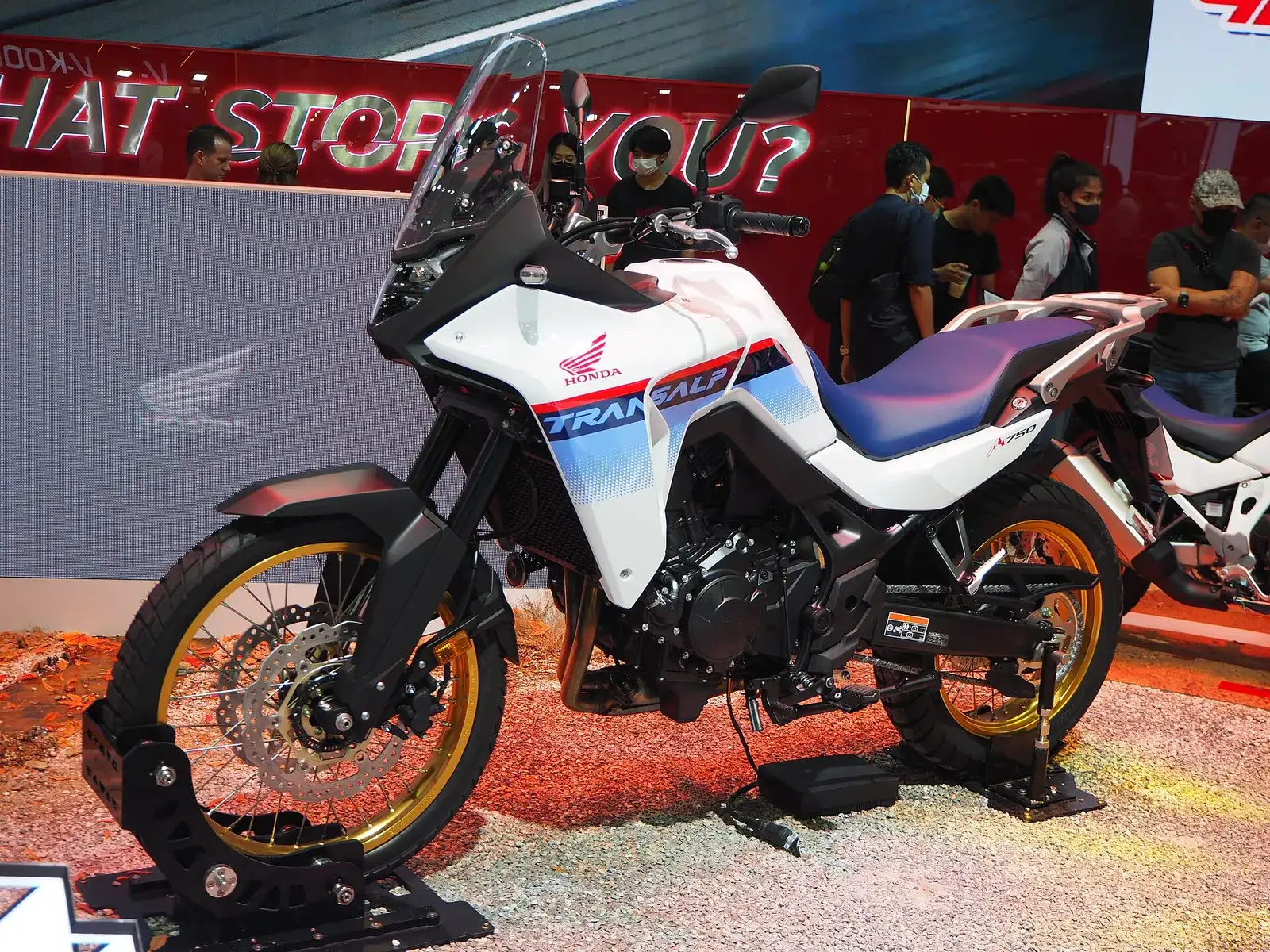
Photo: Chanokchon, CC BY-SA 4.0, via Wikimedia Commons.
Cheapest bike in the table at USD 10,199, third lightest at 212 kg, 91 hp from the 755 cc twin, a 21-inch front on a 150/70-18 rear, and for 2026 an E-Clutch that lets you stop and start without the lever, fully adjustable Showa suspension at both ends and a skid plate, which were the three things the 2025 bike lacked (Cycle News). The 16.9 l tank at 4.3 l/100 km gives 272 km with a 30 % penalty, enough for Bajo Caracoles at 1.21×. The suspension, 200 mm front and 190 mm rear, is the shortest of the 21-inch bikes and you feel it on fast washboard; the 850 mm seat and the 161 Honda listings in Argentina are the reasons a rider whose trip is three-quarters pavement should buy it over the Ténéré. It is the bike we would recommend to someone buying their first adventure motorcycle for a long trip in South America, and now the table says so too.
2. KTM 890 Adventure R: the most capable, at a price
When the road ends this is the bike. Two hundred and forty millimeters of WP XPLOR travel at both ends, 263 mm of ground clearance, a 20 l tank slung low under the engine that gives 315 km with the 30 % penalty, the longest range in the table together with the V-Strom, and 105 hp that are still 54 on the Acay. It also has the longest service schedule here: 15,000 km oil, 30,000 km valves. The 2025 facelift changed nothing that matters, and the 2026 US price is USD 16,299 plus USD 800 freight (KTM). What keeps it second is the 880 mm seat, the price score of 5.1, and a dealer network we could not count from the locator and would not score above 6 if we could. Our full case for it is in the top 3 off-road adventure motorcycles. Drop the dealer criterion to zero and it is first.
3. Honda CRF1100L Africa Twin: the big one that still works off-road
Technically over the class limit at 1,084 cc, but it belongs here because it is the big bike that gravel riders actually buy instead of a 1,300. The standard model, not the Adventure Sports, is the one in the table: 231 kg, 230 and 220 mm of travel, 250 mm of clearance, tubeless 21/18 wheels, an 18.8 l tank at 4.9 l/100 km for 266 km with the penalty, 102 hp and USD 14,799, USD 15,599 with the DCT (Motorcyclist). It takes the best two-up score in the table apart from the Tiger and ties the Tiger and the Ducati on highway stability, and it shares Honda’s network. The weight is there every time you pick it up and it drags the weight score to 4.0; the 18.8 l tank is small for the engine. For a paved-passes trip with a passenger it is first, and the scenario table below shows it.
4. Yamaha Ténéré 700: still the one that keeps working
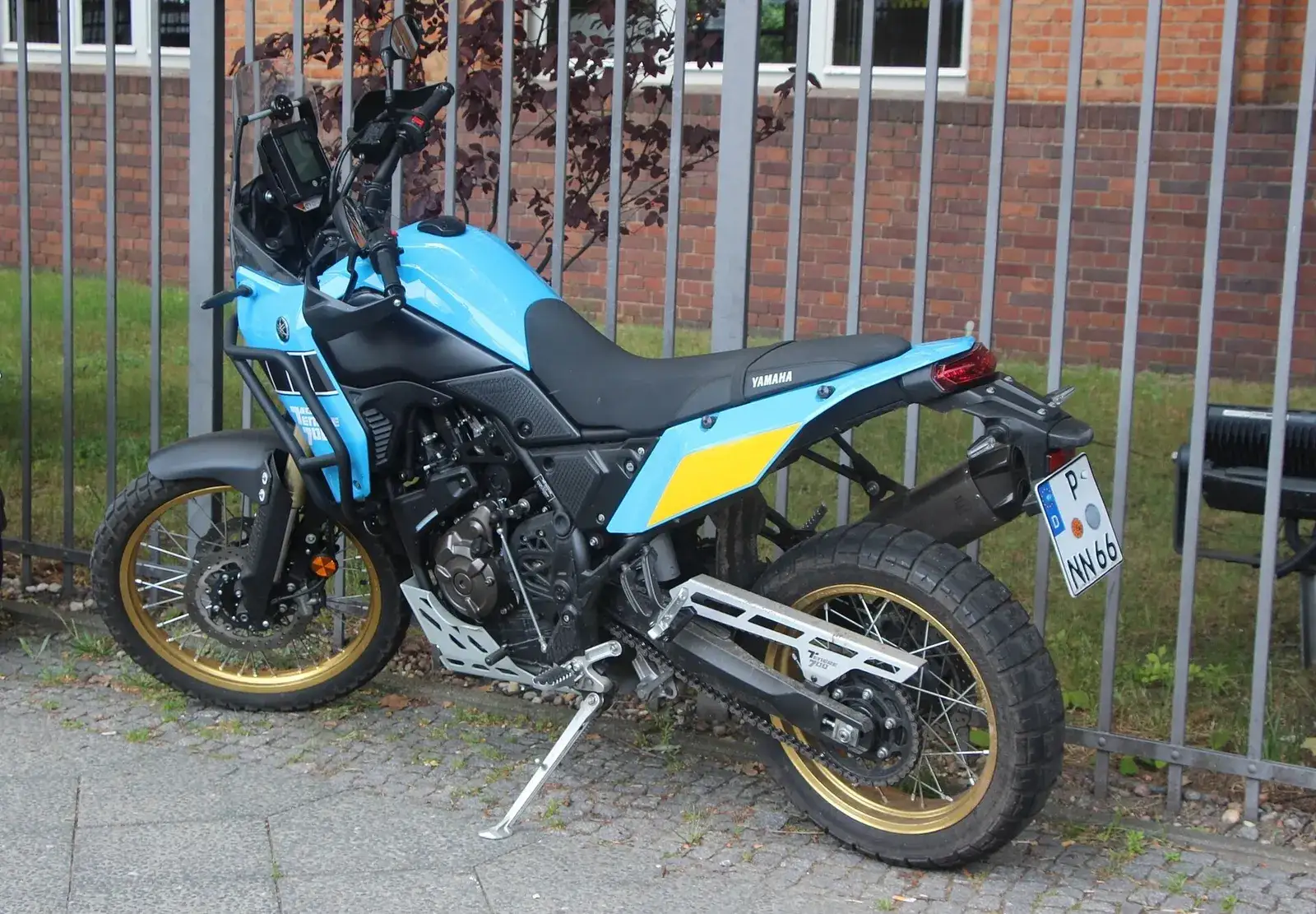
Photo: Wikisympathisant, CC BY-SA 4.0, via Wikimedia Commons.
The bike that tops most other lists, and the one most riders arrive with. Second lightest at 208 kg, second cheapest at USD 10,999, the simplest electronics in the group even after the 2025 update added ride-by-wire, switchable traction control and a 6.3-inch TFT, and enough suspension to float over the washboard of Ruta 40 without slowing down. Why fourth and not first? Because we score what the fans forgive. The 16 l tank gives 258 km with the headwind penalty, a 1.11× margin on the Río Mayo gap that no other 21-inch bike except the BMW does worse on; the 875 mm seat and 72 hp, 37 on the Acay, give it the lowest two-up score in the table; and the 2026 US spec sheet still lists fuel economy as “to be determined”. The 2026 World Raid fixes the tank with 23 l for USD 12,999 at 220 kg, and run through the same scoring it comes out at 8.0, level with the Transalp at the top. If the trip has more gravel than pavement and you ride alone, nothing on this list is a better buy, and the scenario table says exactly that. We compared it directly with the CFMoto in CFMoto 800MT Explore vs Ténéré 700.
5. Aprilia Tuareg 660: the best hardware, the smallest network
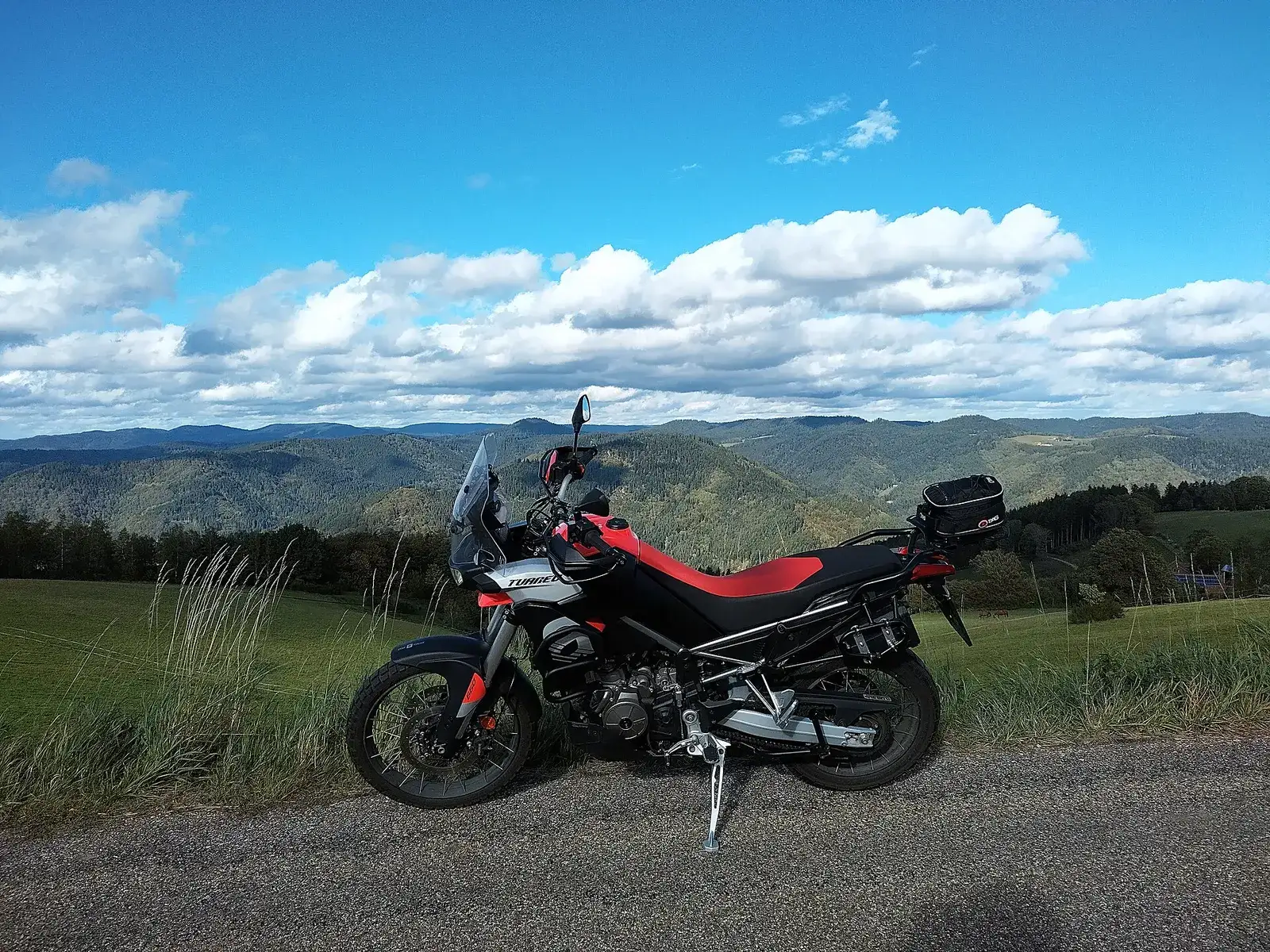
Photo: Makoia, CC0, via Wikimedia Commons.
Lightest bike in the table at 204 kg, 240 mm of travel at both ends like the KTM, the lowest published consumption of the ten at 4.0 l/100 km, and an 18 l tank that gives 312 km with the penalty, which clears every gap in the atlas at 1.34× or better. On hardware alone it is first, with 10 on weight, 10 on gravel and 9.5 on range. It is fifth because of the two criteria that are not about the bike: a 3.0 on two-up, with 80 hp, an 860 mm seat and no weight to settle a passenger, and a 4.0 on dealers, with 14 Motoplex stores in Argentina, none south of Neuquén, and nothing we could verify in Chile. The 2026 Tuareg Rally, USD 13,999, is 11 lb lighter with a retuned bottom end, stiffer springs and a taller, narrower seat (Cycle News); it is the better gravel bike and the worse Shared Ride bike. If you ride where Aprilia has support, move it up two places.
6. Suzuki V-Strom 800DE: the one we added for 2026
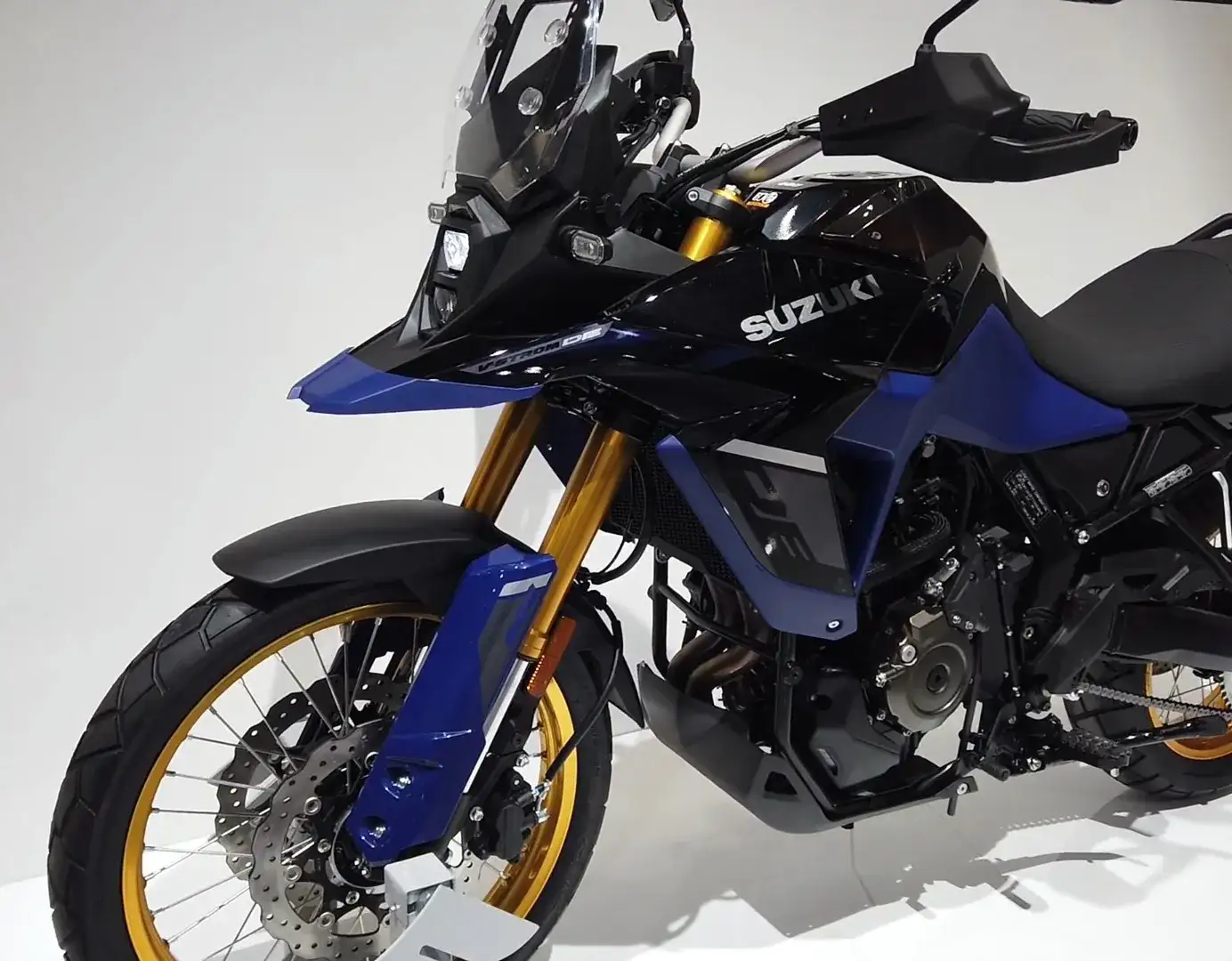
Photo: GIM - Giri in Moto, CC BY 3.0, via Wikimedia Commons.
A 776 cc twin with 83 hp, a 20 l tank at 4.4 l/100 km, so 315 km with the penalty and the joint longest range in the table, 220 mm of fully adjustable travel at both ends, 220 mm of clearance, a 21-inch front, traction control with a Gravel mode and a rear ABS you can switch off, for USD 11,799 (Suzuki). That is a 9.7 on range and an 8.8 on gravel for the price of a Ténéré. What it cannot hide is 230 kg: Africa Twin weight with 20 hp less, which is 42 hp on the Acay with two people up. The tube-type wheels and the 150/70-17 rear cost it a point on running cost against the Hondas. Suzuki’s dealer count we could not verify, which is why its 6 is marked provisional; the brand restarted local production in Argentina in June 2026.
7. Triumph Tiger 900 Rally Pro: the premium all-rounder
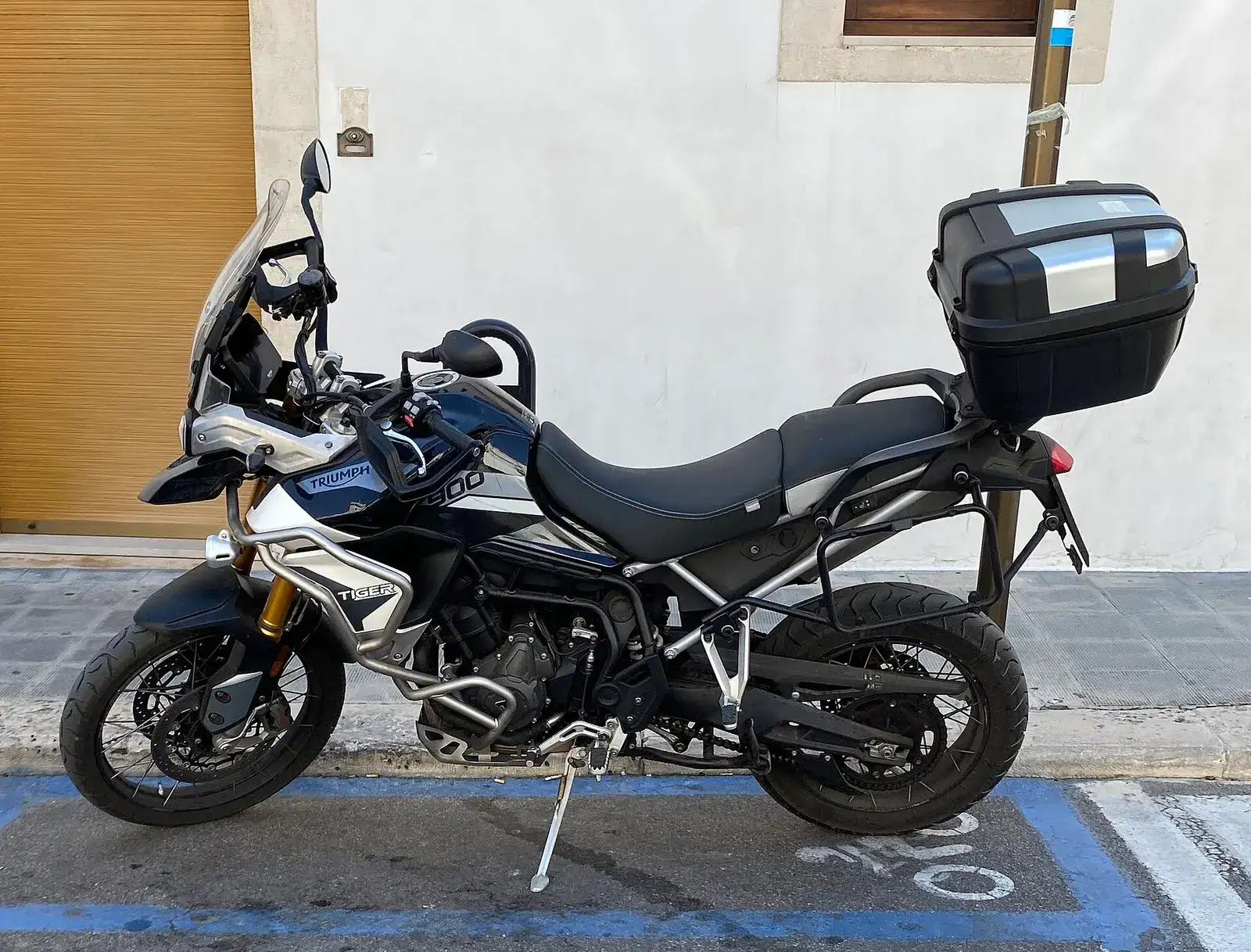
Photo: Corvettec6r, CC BY-SA 4.0, via Wikimedia Commons.
The T-plane triple makes 106.5 hp since the 2024 update, up from 93.9, and it is the best engine in the table for a mixed route: torque on gravel, smooth at 130 km/h. The equipment is the most complete here, heated grips and seats, cruise control, 240 and 230 mm of travel, a 20 l tank, and the valve check moved to 18,000 mi, with a 10,000 km or 12-month service (Triumph). It takes the top two-up score, 9.0, and ties the top highway score. It is seventh because the method punishes exactly what you pay for: USD 17,595 is the highest price in the table and a 4.0, 228 kg is a 4.7, and 5.2 l/100 km on Triumph’s own US figure makes the 20 l tank worth 266 km with the penalty, the same as the Africa Twin’s 18.8. We reviewed it at length in our 2024 Tiger 900 Rally Pro review; on a trip that is mostly paved passes with a passenger, like the Andes Crossing, it is second only to the Africa Twin.
8. BMW F 900 GS: fast, light for a BMW, and 14.5 liters
Fourteen and a half liters is the smallest tank in the table, on a 105 hp engine at 4.4 l/100 km. That single number is the 4.6 on range and the reason it is eighth: 228 km with the penalty, 0.98× of the Río Mayo gap and 1.01× of Bajo Caracoles. On Ruta 40 south of Perito Moreno it needs a fuel bladder, full stop. The rest of the bike is excellent: 219 kg, 230 and 215 mm of travel, a 21-inch front, 105 hp, USD 14,275 for 2026 after BMW cut the price of the Premium package. BMW Chile has four points of sale and none south of Viña del Mar; Argentina’s locator we could not count. On a route with fuel every 150 km, the Andes Crossing for instance, where the longest gap is the 135 km of the Hua Hum crossing, it would be top four.
9. CFMoto 800MT Explore: the equipment bargain, on the road
Ninety-four hp (US sheet; 91 in Europe) of KTM-derived LC8c twin, a 19 l tank, cruise control, heated grips and seat, a quickshifter, cornering ABS, blind-spot radar, a center stand and an 8-inch TFT with CarPlay, all standard, for USD 10,299 in the US as the Ibex 800 E. It scores 9.9 on price and 9.0 on two-up and it is ninth because of 231 kg, a 19-inch front and suspension travel CFMoto does not publish and 1000PS lists at 140 and 145 mm: a 1.1 on gravel. It is a road bike that tolerates gravel, and the US manual’s 5,000 km oil interval, three times shorter than the European one, is a cost most buyers do not see coming. For a rider who will spend 80 % of the trip on pavement, two-up, it is a far better buy than its position suggests, and we said so in our CFMoto 800MT Explore review and in Chinese motorcycle brands ranked by reliability. If you want a CFMoto for gravel, the 800MT-X is a different machine: 21/18 tubeless wheels, 230 mm of travel, 22.5 l.
10. Ducati Multistrada V2: the fast road bike in adventure clothes
The 2025 bike is new and much better than the one most rankings still describe: an 890 cc V2 with 115 hp instead of the 937 cc with 113, 199 kg without fuel, 18 kg lighter than before, and the valve check at 30,000 km with a 15,000 km or 24-month service (Cycle News). It takes the best altitude number in the table, 59 hp on the Acay, and ties the top highway score. It is tenth for the job we described because 170 mm of travel on 19 and 17-inch road tires is a 2.8 on gravel, 5.5 l/100 km on a 19 l tank is 239 km with the penalty, and the dealer network in Argentina and Chile is the smallest of any brand here. On the paved switchbacks of the Quebrada de las Conchas it is the most entertaining bike in the table by a distance. On the first gravel stretch it is the one everybody wants to swap.
How the ranking changes with the trip
Same scores, different weights. These are the four questions we get most, each with the weights we would use and the top of the table it produces.
Mostly gravel, light luggage, solo. Weight 20, gravel 30, range 15, dealers 15, running cost 10, price 10; highway and two-up at zero. Tuareg 8.6, KTM 8.4, Ténéré 8.4, Transalp 8.3, Africa Twin 7.5. The three lightest bikes with the most travel, with the Transalp holding on through price and dealers. The CFMoto and the Ducati drop to 4.8 and 5.1.
Mostly paved passes, some gravel, two-up. Weight 5, gravel 10, range 10, highway 25, two-up 25, dealers 10, running cost 5, price 10. Africa Twin 8.0, Tiger 900 Rally Pro 7.7, CFMoto 800MT Explore 7.4, Transalp 7.4, KTM 7.1. Comfort and torque for two, with enough suspension for the gravel days; the Ténéré falls to last at 5.7, which is the honest answer for a Shared Ride pair on it.
Ruta 40 south, the long fuel gaps. Range 35, gravel 15, weight 10, highway 10, dealers 10, price 10, two-up 5, running cost 5. KTM 8.3, Tuareg 7.9, V-Strom 7.8, Transalp 7.8, Africa Twin 7.5, Ténéré 7.2, BMW 6.3. Anything with 18 l or more and a published consumption under 4.5. The fuel range calculator runs each of these bikes through every segment, and the fuel station list has the pumps themselves.
You have support at home and will never need a dealer here. Dealer weight to zero, the rest scaled up. KTM 8.0, Tuareg 7.9, Transalp 7.7, Africa Twin 7.2, V-Strom 7.2, Tiger 7.1. This is the ranking most magazines publish, because it is the one that ignores geography, and the KTM wins it.
Budget under USD 11,000. Not a reweighting, a filter: Transalp, Ténéré and CFMoto 800MT Explore. Three different answers to the same question, and all three good; the first is the all-rounder, the second the gravel bike, the third the road bike for two.
What we ride, and why
Our own fleet sits in this class on purpose. A 500 to 850 cc adventure bike is light enough for the gravel of the Lake District and the puna and strong enough for the highways between them, and it is the size a rider who has never been on gravel can learn on in a day. Which models we run changes with the season and with what the dealers in Chile and Argentina can support, which, as the dealer table shows, is a bigger factor than the spec sheet suggests. The motorcycles are Chilean-registered and cross the border under the Chilean rental regime, so the Chilean side of the network is the one that matters to us day to day.
If you want to ride one of these across the Andes before you buy it, that is one of the better reasons to join a guided tour. The Andes Crossing and the Andean Highlands both run on this class of motorcycle, and ten days on one tells you more than any ranking, including this one. For the rest of the buying question, which adventure bike for the Andes covers the engine-size decision and our mid-range touring guide goes deeper on five of these bikes.
FAQ
What counts as a middleweight adventure bike? Roughly 650 to 900 cc and 200 to 230 kg wet, with a 19 or 21-inch front wheel. We include the 1,084 cc Africa Twin because it competes for the same riders at the same weight, and we leave out the 1,200 and 1,300 cc flagships, which are a different kind of trip, and the 450s, which lose a third of their 40-odd hp by the time they reach the Salinas Grandes.
Is the Ténéré 700 really not the best middleweight adventure bike? On capability per dollar for gravel, alone, it is still the best buy in the class, and in the gravel scenario above it scores within 0.4 of the leader. It is fourth overall because a 16 l tank gives it 258 km in a headwind, less than any other 21-inch bike here except the BMW, and because an 875 mm seat and 72 hp make it the worst bike in the table for two riders. If those two things do not describe your trip, move it up.
Which middleweight has the longest range? The KTM 890 Adventure R and the Suzuki V-Strom 800DE, 20 l tanks at 4.4 l/100 km, about 315 km with a 30 % penalty for gravel and wind; the Tuareg 660 is 3 km behind on 18 l because it is the most frugal. The BMW F 900 GS is last at 228 km, which does not cover the 232 km Gobernador Costa to Río Mayo gap on Ruta 40.
Which is the best middleweight adventure bike for a short rider? By seat height: the CFMoto 800MT Explore at 825 mm, the Multistrada V2 at 830, then the Transalp and the Africa Twin at 850. The Ténéré, BMW and KTM sit at 870 mm or more and usually need a lower seat; Yamaha’s low seat takes the Ténéré to 860 mm.
How much power do these bikes lose at altitude? About 3 % per 300 m for a naturally aspirated engine. At the 4,895 m of the Abra del Acay that is roughly half: the Ténéré’s 72 hp becomes 37, the KTM’s 105 becomes 54, the Multistrada’s 115 becomes 59. Fuel injection corrects the mixture but cannot replace the missing oxygen.
Do I need to bring my own bike to ride with you? No. The motorcycle is included on our tours, and the bikes we run are chosen from this class for the roads we ride. See the Argentina and Chile motorcycle tours page for the two routes and the border crossing checklist for what your own bike would need at the Chilean customs.